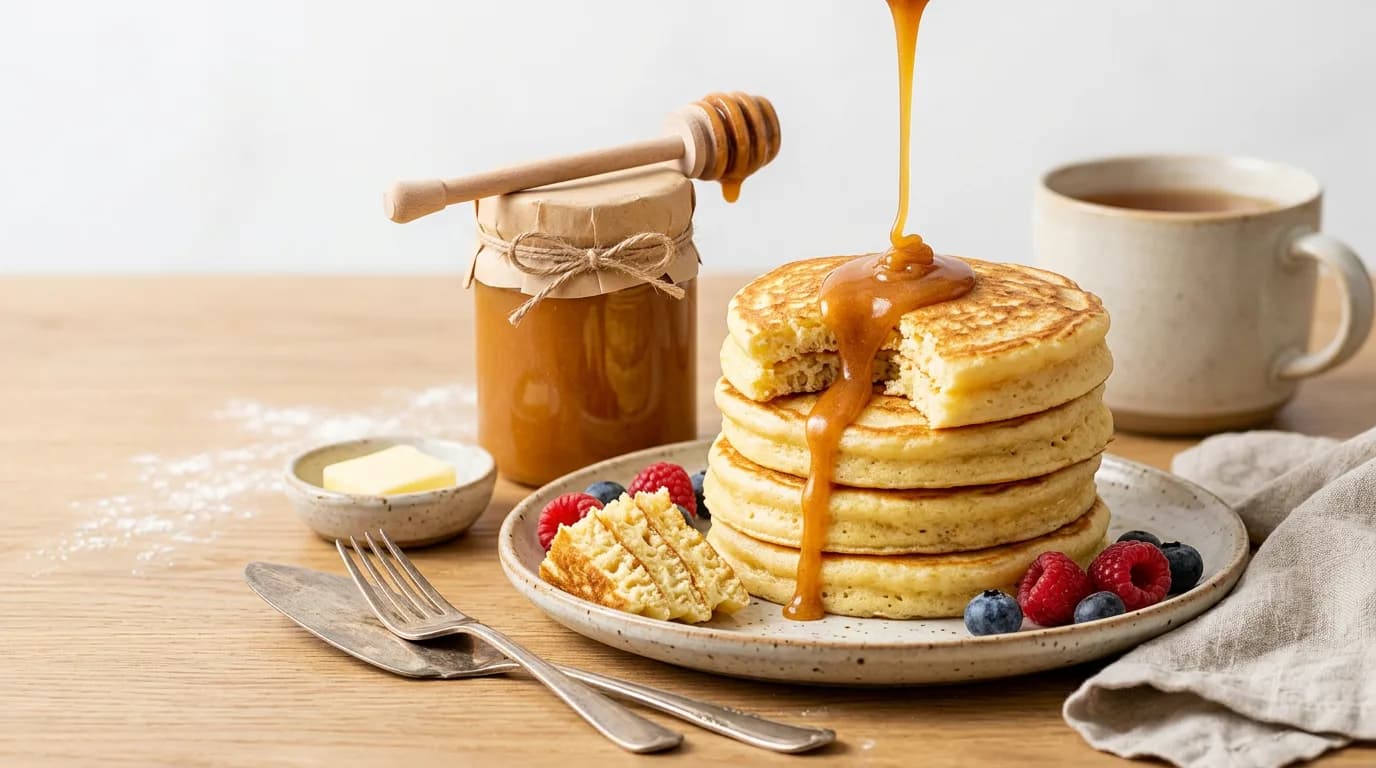
Essential Takeaways
These fluffy, American-style pancakes use authentic Manuka honey as a natural sweetener to create a light, comforting breakfast that tastes indulgent while avoiding refined sugar — simple to make, full of flavour, and perfect for slow mornings or easy brunches.
Transform your breakfast routine with these light, fluffy, American-style pancakes sweetened naturally with Manuka honey. This wholesome recipe combines simple ingredients with a distinctive New Zealand ingredient for a morning meal that tastes delicious.
These light, fluffy pancakes are designed for relaxed mornings, slow weekends, or any time you want a comforting breakfast made with high-quality ingredients. Naturally sweetened with Manuka honey instead of refined sugar, they strike a nice balance between wholesome ingredients and comfort-food satisfaction — without complicated techniques or hard-to-find ingredients.
Whether you're cooking for family, hosting brunch, or simply treating yourself, this recipe delivers soft, golden pancakes with a rich depth of flavour that authentic Manuka honey brings. Below, alongside the recipe itself, we've added a bit more context on what Manuka honey actually is, how it's graded, and what current research does — and doesn't — tell us about it, so you can enjoy this breakfast with realistic expectations.
Why You'll Love This Recipe
Traditional pancake recipes rely heavily on refined sugar and butter, which can leave you with an energy dip by mid-morning. By using Manuka honey as a natural sweetener instead, you get a breakfast with a distinctive depth of flavour. It's worth being clear from the outset, though: Manuka honey is still a form of sugar, and while its chemistry is genuinely distinctive (more on that below), eating it in a pancake is a food choice, not a treatment for anything.
- Naturally sweetened with Manuka honey
- Light, fluffy texture every time
- Made with simple, everyday ingredients
- Ready in around 20 minutes
- Easy to adapt for different dietary preferences
- Makes 8 to 10 pancakes
Manuka honey adds more than sweetness. Its distinctive flavour and natural viscosity help create fluffy pancakes with a depth of flavour that regular syrup or sugar can't match. You'll notice the difference from the first bite.
What You'll Need: Ingredients and Equipment
The beauty of this recipe is its simplicity, as most ingredients are pantry staples.
Dry ingredients
- 190 g plain flour
- 2 tsp baking powder
- ½ tsp bicarbonate of soda
- ¼ tsp fine sea salt
Wet ingredients
- 2 tbsp Manuka honey (UMF™ 10+ recommended)
- 300 ml buttermilk*
- 1 large egg, at room temperature
- 3 tbsp melted butter or coconut oil
- 1 tsp vanilla extract
*If buttermilk is unavailable, mix 300 ml milk with 1 tbsp lemon juice and let it stand for 5 minutes.
A quick note about the honey: choosing an authentic UMF™ certified variety ensures you're getting genuine New Zealand honey with verified quality. The UMF™ rating doesn't affect taste in this recipe, so a UMF™ 10+ works perfectly without breaking the budget. It's also worth understanding what that UMF™ number is actually measuring — we've unpacked this in more detail further down, because it's more nuanced than 'higher is simply better.'
Equipment
- Large mixing bowl and medium bowl
- Whisk or electric mixer
- Non-stick frying pan or griddle
- Measuring scales and spoons
- Spatula
Step-by-Step Guide: Making Perfect Fluffy Pancakes
Now for the fun part. This process is straightforward, but paying attention to a few key details will take your pancakes from good to great.
Prepare your dry ingredients
In your large mixing bowl, whisk together the flour, baking powder, bicarbonate of soda, and salt. Make sure there are no lumps. This ensures even distribution of the raising agents, which is crucial for a uniform texture. Set this bowl aside while you tackle the wet ingredients.
Mix wet ingredients with Manuka honey
In your medium bowl, whisk the egg until slightly frothy. Add the buttermilk, melted coconut oil, vanilla extract, and Manuka honey. Whisk vigorously until the honey is completely incorporated and the mixture looks uniform. The honey should dissolve smoothly into the liquid without any sticky clumps remaining. Try to use lukewarm, not hot, liquids here — very high heat isn't necessary and, as we discuss below, is worth avoiding with Manuka honey generally.
Combine wet and dry ingredients
Pour the wet mixture into the dry ingredients. Here's the critical part: stir gently with a wooden spoon or spatula until just combined. You should still see small lumps in the batter. Overmixing develops the gluten and results in tough, flat pancakes. About 10–15 gentle folds should be enough. Let the batter rest for 5 minutes while your griddle heats up.
Heat your cooking surface
Preheat your frying pan or griddle over a medium heat. Lightly grease with coconut oil or butter. To test if it's ready, sprinkle a few drops of water on the surface — they should sizzle and evaporate.
Cook the first side
Pour 60 ml of batter onto the frying pan for each pancake. Don't spread it out; let it settle naturally into a circle. Wait for bubbles to form on the surface and the edges to look slightly dry. This takes about 2–3 minutes. Resist the urge to lift the pancake too early.
Flip and finish cooking
When bubbles cover most of the surface and the edges look set, slide your spatula under and flip your pancake. The second side cooks faster, about 1–2 minutes. You're looking for a beautiful golden-brown colour. Transfer to a warm plate and repeat with the remaining batter.
Serve immediately with toppings
Drizzle with additional Manuka honey, fresh berries, yoghurt, or a sprinkle of chopped nuts and serve while warm for the best texture and flavour.
Tips for perfect pancakes
Here are a few tips for the perfect fluffy pancake — these will help you achieve great texture and flavour every single time.
Expert tips:
- Room-temperature ingredients mix more smoothly and create a better texture. Take your egg and buttermilk out of the fridge 30 minutes before cooking.
- Don't press down on pancakes with your spatula. This squeezes out the air bubbles you worked hard to create, resulting in dense pancakes.
- Keep finished pancakes warm in an 80°C oven on a wire rack. This prevents them from getting soggy while you finish the batch.
- Warm your Manuka honey slightly before drizzling for easier pouring and better distribution. Just 10 seconds in warm water does the trick.
- Add mix-ins like blueberries or chocolate chips after pouring the batter onto the hot pan, not into the bowl. This prevents overmixing.
A special note about storing Manuka honey: keep it at room temperature in a cool, dark place.
Flavour Variations
- Lemon & Poppy Seed: Add the zest of one lemon and 1 tablespoon of poppy seeds to the batter.
- Banana & Walnut: Mash one ripe banana into the wet ingredients and add 50 g of chopped walnuts.
- Cinnamon Spice: Add 1 teaspoon of cinnamon and ¼ teaspoon of nutmeg to the dry ingredients.
- Berry: Gently fold in 100 g of fresh raspberries or blueberries before cooking.
Common Mistakes to Avoid
Here are some common pancake pitfalls and how to avoid them:
- Overmixing the batter: A few lumps in the batter mean tender, fluffy pancakes.
- Cooking at too high a heat leads to burnt outsides and raw centres. Medium heat gives you control and even cooking.
- Flipping too early: Wait for the bubbles and set edges. Flipping too early causes pancakes to fall apart or cook unevenly.
- Using old ingredients: Baking powder and bicarbonate of soda lose potency over time.
- Skipping the resting period: Those five minutes allow the flour to hydrate and the raising agents to activate.
One mistake specific to using Manuka honey: don't heat it directly on the stove or microwave at high temperatures. Excessive heat can degrade some of the natural compounds that make Manuka honey distinctive. Mix the Manuka honey into room-temperature or slightly warm ingredients for best results. This is a good general habit even setting aside any potential effect on flavour or composition, since honey (like any sugar) can scorch and turn bitter when overheated.
Storage
Allow pancakes to cool completely before storing. Keep refrigerated for up to 2 days, or freeze with baking paper between the layers for up to 2 months. Reheat gently in a toaster or pan.
Why Manuka Honey?
You might be wondering: why go through the effort of using authentic, certified Manuka honey when regular honey or maple syrup would work? The answer lies in what makes Manuka honey distinctive — though it's worth being precise about what the underlying research actually shows, and what it doesn't.
Manuka honey comes from bees that pollinate the Manuka tree, native to New Zealand. This creates a honey with unusual properties that go beyond simple sweetness. When you choose UMF™ certified Manuka honey, you're getting independently tested, traceable honey that meets strict quality standards. It's one of the few ingredients that brings both exceptional flavour and a genuinely distinctive chemical profile.
That distinctiveness is best documented at the chemical level. Manuka honey's reputation for potency is rooted in a genuine, well-characterised chemical marker: methylglyoxal (MGO), which laboratory analysis has identified as the compound most responsible for its antibacterial activity, present at concentrations far higher than in other honeys. This evidence comes from chemical assays and bacterial-inhibition testing in the lab, not from studies of honey consumed as food. In other words, MGO is real and measurable, but its presence tells us about how Manuka honey behaves in a petri dish or a wound dressing, not necessarily what happens once it's stirred into pancake batter and eaten at the breakfast table.
Separately, chemical assay work on raw Manuka honey samples found that antioxidant capacity, as measured by a standard laboratory reducing-power assay, correlated closely with both UMF grade and total phenolic content. This is a chemistry-bench finding on unheated honey; it does not establish that this antioxidant capacity survives cooking or confers a measurable health benefit when the honey is used in a baked or pan-cooked recipe such as pancakes. Given that this recipe involves warming and cooking the honey as part of the batter, it's sensible to enjoy it primarily for its flavour rather than to expect any laboratory-measured antioxidant properties to carry through fully to your plate.
More broadly, a review of the chemistry and biological activity of Manuka honey notes that its documented antimicrobial and antioxidant effects have chiefly been demonstrated in laboratory settings and in topical wound-treatment contexts, using medical-grade dressings rather than the food-grade honey used in cooking. This body of evidence does not directly speak to outcomes from eating Manuka honey in a recipe, and the two contexts (medical-grade topical use versus food-grade culinary use) should not be conflated when describing a food such as pancakes. We mention this because it's easy to see headlines about Manuka honey's wound-care properties and assume they apply equally to a spoonful on your breakfast — the honest answer is that they're separate bodies of research.
On the ingestion side specifically, the only identified human trial on ingesting Manuka honey (a randomised, double-blind crossover study of 20 healthy adults consuming 20 g/day for four weeks) found it to be safe — no allergic response and no increase in glycation markers — but it did not detect any beneficial change to gut bacterial populations relative to a standard multifloral honey. This means that, based on current evidence, claims that eating Manuka honey supports digestive health or 'nourishes the body' beyond its nutritional content as a sugar source are not supported by clinical data; this trial did not test cooked or baked honey specifically, and this recipe page should not be read as suggesting any digestive or therapeutic benefit. We include this recipe for its flavour and the enjoyment of cooking with a distinctive, traceable New Zealand ingredient — not as a wellness intervention.
Finally, a 2024 review of Manuka honey research explicitly identifies grading systems, safety/efficacy, and marketed 'implied benefits' as unresolved, debated areas within the literature. This supports a cautious framing of any health claim attached to Manuka honey as an ingredient in this recipe, rather than presenting such benefits as settled fact. We'd rather you enjoy these pancakes with clear eyes about what's proven, what's promising-but-unproven, and what's simply good flavour.
Understanding UMF™ Ratings
The UMF™ (Unique Manuka Factor) rating is an independent quality mark that verifies authenticity and potency. For cooking and general use, UMF™ 10+ or UMF™ 15+ offers excellent value. Every batch is traceable back to its source in New Zealand's remote landscapes.
It's worth noting, though, that a higher UMF™ number does not always translate to straightforwardly 'stronger' honey in every measurable sense. While UMF grading is intended to reflect a honey's MGO content, laboratory testing against a range of bacterial isolates found that the relationship between UMF rating and measured antibacterial strength was inconsistent — in one such study, a lower-graded honey was sometimes more active than a higher-graded one. This suggests UMF number alone should not be read as a straightforward measure of potency, though this has not been tested for honey used as a food ingredient rather than a topical antibacterial agent. For a pancake recipe, this is largely academic — as noted above, UMF™ 10+ is a perfectly good, budget-friendly choice for cooking, since the rating is primarily a marker of authenticity and traceability rather than a guarantee of how the honey will perform once it's in your batter.
Frequently Asked Questions
Can I substitute regular honey or maple syrup for Manuka honey?
You can substitute other liquid sweeteners in equal amounts, but you'll miss out on the unique flavour profile that makes this recipe special. Regular honey will give you sweet pancakes, but Manuka honey delivers that distinctive rich, slightly earthy complexity along with its well-documented (if largely lab-based) chemical distinctiveness, discussed in more detail above.
How do I make these pancakes gluten-free or dairy-free?
For gluten-free pancakes, use a gluten-free flour blend designed for baking. Add an extra tablespoon of liquid, as gluten-free flours absorb more moisture. For dairy-free, replace the buttermilk with your favourite plant milk mixed with 1 tablespoon of lemon juice (let it sit for 5 minutes), and use coconut oil instead of butter.
Why are my pancakes flat instead of fluffy?
Flat pancakes usually result from expired raising agents (check the dates on your baking powder and bicarbonate of soda), overmixing the batter, or cooking at too low a temperature. Make sure you see active bubbles forming while cooking and that your batter still has visible lumps after mixing.
Does cooking with Manuka honey destroy its beneficial properties?
Heat can affect some of honey's delicate compounds, which is part of why we recommend mixing Manuka honey into room-temperature or gently warmed ingredients rather than heating it directly. That said, the laboratory antioxidant and antibacterial findings discussed above were measured in raw, unheated honey and largely in non-food contexts, so it isn't accurate to say cooking either 'preserves' or 'destroys' a specific consumer health benefit — the honest answer is that this particular question, for honey used as a cooked food ingredient, hasn't been directly studied.
Manuka honey is not a replacement for professional medical advice. If you are unwell, please consult a qualified healthcare professional, and always seek medical care in an emergency.