Essential takeaways
Manuka honey is a unique type of honey with antibacterial properties that can be part of a healthy diet, though many of its specific health benefits are still being researched.
Making your own Manuka honey chews is easy and requires only a few ingredients.
Store your Manuka honey chews in an airtight container in the fridge to keep them fresh and tasty.
As with any honey product, these chews are not suitable for infants under 12 months old.
Manuka honey is not your average honey.
It has been found to contain high levels of a compound called methylglyoxal (MGO), which gives it antibacterial properties. Laboratory chemical analysis has identified MGO as the compound primarily responsible for Manuka honey's antibacterial activity in vitro (in bacterial culture assays), found at concentrations up to 100 times higher than in other honeys. It's worth noting this is a chemical and mechanistic finding from lab testing, not a claim about health outcomes in the human body — and it's distinct from medical-grade Manuka honey wound dressings, which are regulated medical products. Everything in this guide is about food-grade Manuka honey used in a home recipe.
Manuka honey has long been associated anecdotally with immune support and digestive benefits, though the research picture is more nuanced than popular claims suggest — more on that below.
So if you're looking for a tasty and healthy snack, Manuka honey chews might be just what you need.
These chews are easy to make at home and can be a great alternative to processed snacks.
In this guide, we provide an easy base recipe plus four ways you can customise your chews to your health and wellness goals.
In this Manuka honey chews recipe, you'll find:
-
Why should you eat Manuka honey?
-
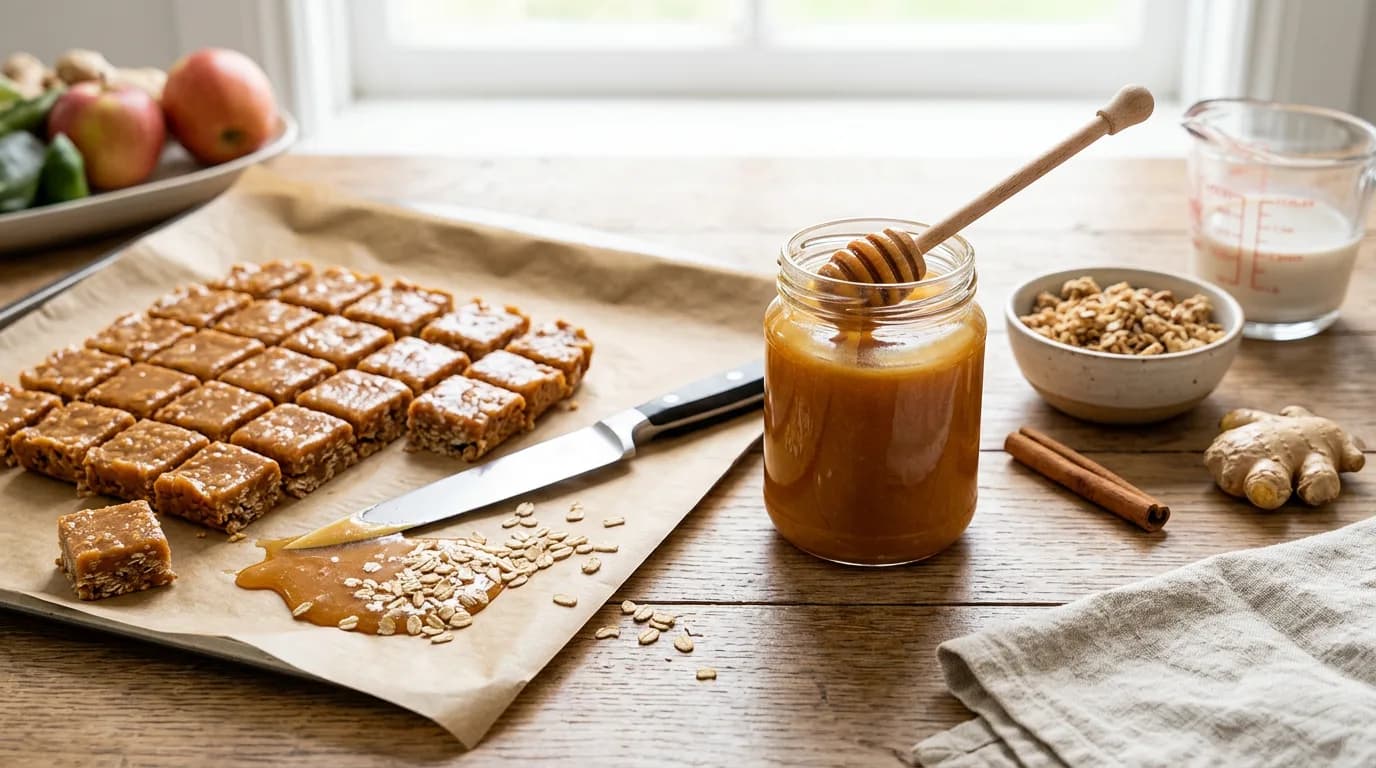
Your customisable Manuka honey chews recipe
-
How to store your Manuka honey chews
-
Cautions and safety notes
-
The best Manuka honey for health benefits
Why eat Manuka honey?
If you're looking for a natural way to support your wellbeing or soothe a sore throat, Manuka honey may be worth exploring as part of a varied diet.
This special type of honey, which comes from New Zealand, has been used for generations and is associated with antibacterial, anti-inflammatory, and antioxidant properties.
It is rich in an antibacterial compound called methylglyoxal (MGO), which is responsible for many of its recognised properties. As noted above, MGO has been chemically quantified in laboratory settings at levels far exceeding those found in conventional honey — this is part of what sets Manuka apart chemically, even though lab findings don't automatically translate into guaranteed outcomes for every person who eats it.
MGO has been studied for its potential to help reduce inflammation markers, which is of interest for conditions such as arthritis and other inflammatory concerns, though this should not be read as a treatment claim.
In addition to its antibacterial and anti-inflammatory associations, Manuka honey also contains antioxidants that may help offset everyday oxidative stress caused by free radicals. Laboratory chemical assays measuring ferric-reducing antioxidant power (FRAP) show that Manuka honey's antioxidant capacity, tested in vitro, correlates strongly with its UMF™ rating and phenolic content. In practical terms, this means higher-UMF™ honeys tend to show greater measurable antioxidant activity in a test tube — but this describes chemistry in a lab setting, not a demonstrated reduction in oxidative stress or disease risk in the body from eating honey chews.
This kind of antioxidant activity is sometimes discussed in relation to long-term wellness, though robust human evidence for reduced risk of chronic disease from dietary Manuka honey specifically is still limited.
What about immune support and digestion?
You may have come across claims that Manuka honey "boosts the immune system" or "improves digestion." The evidence here is mixed and worth understanding clearly.
On the immune side, an in-vitro cell culture study suggests Manuka-honey-derived methylglyoxal can enhance activation of a specific immune cell type called MAIT cells, which help the body detect microbes. This is interesting laboratory evidence of a possible mechanism, but it has not been tested in humans who are actually consuming honey, and it does not establish that eating Manuka honey chews measurably boosts your immune system or protects you against illness.
On the digestion side, the picture is more corrective than confirmatory. A randomised, double-blind crossover trial in 20 healthy adults found no measurable change in gut bacterial populations after 4 weeks of daily Manuka honey (UMF™ 20+) consumption, despite popular claims about digestive benefits. We're including this here to correct a common misconception, not to suggest any particular digestive outcome from eating these honey chews.
The same trial did offer some reassuring safety data: there was no significant increase in allergy markers (IgE) or in an advanced glycation end-product called CML after 4 weeks of daily Manuka honey intake, in that specific group of healthy adults. This is a useful data point for general safety, but it hasn't been studied in people with existing honey allergies, diabetes, or other chronic conditions, in pregnant people, or over longer time periods than four weeks.
A note on oral health
Interestingly, because these chews are eaten by, well, chewing, there is some early evidence relevant to oral health specifically. A small 21-day pilot trial (n=30) found that chewing a Manuka honey confectionery was associated with lower plaque scores and gingival bleeding compared with sugar-free gum. This is preliminary evidence from one small study, and we're sharing it here for information only — it is not a recommendation to use this chew as a treatment for gum disease or bleeding gums. If you notice persistent or worsening gum bleeding, please see a dentist or clinician rather than relying on a food recipe.
NB: While Manuka honey is generally well tolerated, it's important to note that some people are allergic to honey. If you have a honey allergy, you should avoid consuming Manuka honey to prevent an allergic reaction.
DIY Manuka honey chews recipe
If you're looking for a wholesome and delicious snack that's easy to make, look no further than these DIY Manuka honey chews!
Not only are they packed with the natural goodness of Manuka honey, but they're also gluten-free and dairy-free, making them a great choice for anyone with dietary considerations to keep in mind — though as with any honey-based treat, people managing diabetes should factor the sugar content into their overall plan (see Cautions below).
Ingredients
-
1/2 cup Manuka honey
-
1/2 cup almond milk
-
1/2 cup granola
-
1/2 teaspoon cinnamon
-
1/2 teaspoon ginger
Important: this recipe, like all honey-containing foods, is not suitable for children under 12 months of age. See Cautions below for more detail.
Instructions
-
In a medium-sized bowl, mix together the Manuka honey and almond milk until well combined.
-
Add in the granola, cinnamon, and ginger, and stir until everything is evenly distributed.
-
Line a baking sheet with baking paper, and pour the mixture onto the sheet.
-
Use a spatula to spread the mixture out into an even layer, about 1/2 cm thick.
-
Place the baking sheet in the fridge for at least 2 hours, or until the mixture has hardened.
-
Once the mixture has hardened, use a sharp knife to cut it into small, bite-sized pieces.
-
Store the chews in an airtight container in a cool spot (or fridge) for up to 1 week.
Customise your Manuka honey chews
If you're looking to use your Manuka honey for something more specific, check out these simple variations to boost your personal health and wellness goals.
The protein chew
Manuka honey is a handy source of pre- and post-workout fuel. Add 1/4 cup of your favourite protein powder to the base recipe.
The sweet treat chew
Add 1/2 cup of your favourite dried fruit, such as raisins, cranberries, or chopped dates, to the base recipe. This will give you a satisfying snack that's perfect for your sweet tooth.
The brain health and better focus chew
Add 1 tablespoon of DHA oil to the base recipe. DHA is an omega-3 fatty acid that's important for brain health and function, making this chew a great choice for anyone who needs a little extra brain power.
The calming sleep chew
Add 1 teaspoon of turmeric to the base recipe. Turmeric is a natural anti-inflammatory that some people use to help wind down, making this chew a nice choice for anyone who needs a little help getting to sleep.
No matter which variation you choose, these Manuka honey chews are sure to be a hit! As always, these customisations are food-based suggestions rather than treatments for any medical condition.
How to store your Manuka honey chews
Once you have made your delicious Manuka honey chews, you want to make sure they stay fresh and tasty for as long as possible.
Here are some tips on how to store your Manuka honey chews:
Store in a cool, dry place
Manuka honey chews should be stored in a cool, dry place.
This will help prevent them from becoming too soft or sticky.
Avoid storing them in direct sunlight or near a heat source, as this can cause them to melt or become too soft.
Use an airtight container
To keep your Manuka honey chews fresh, store them in an airtight container.
This will help prevent them from absorbing moisture from the air, which can cause them to become sticky or hard.
You can use a plastic container or a resealable bag to store your chews.
Keep away from strong flavours
Manuka honey chews have a delicate flavour, so it's best to keep them away from strong-smelling foods.
Store them separately from other foods in your fridge, pantry, or cupboard to avoid any cross-contamination of flavours.
Check expiry dates
Make sure to check the expiry date of your Manuka honey chew ingredients before storing them. If they are close to expiring, it's best to consume them as soon as possible or replace with fresh ingredients.
Manuka honey chews can last for several months if stored properly, but it's always best to consume them within a reasonable timeframe.
Cautions and safety notes
Before you get chewing, please keep the following in mind:
-
Never give honey to infants under 12 months old. Honey, including Manuka honey, must never be given to infants under 12 months of age due to the risk of infant botulism. This applies to any homemade honey chew or recipe on this page — do not prepare or offer these for children under 1 year old.
-
This is general information, not medical advice. This page is for general health information only. It does not constitute medical advice, a treatment recommendation, or instructions for diagnosing or managing any condition. Always speak to a qualified clinician about persistent, severe, or worsening symptoms (e.g. ongoing gum bleeding, high fever, or signs of infection) rather than relying on a food recipe.
-
Managing diabetes or blood sugar? People managing diabetes or blood-sugar conditions should account for the sugar content of Manuka honey chews as part of their overall dietary management, and consult their clinician or dietitian as needed.
-
Pregnant or breastfeeding? If you are pregnant or breastfeeding, note that most of the human safety evidence referenced here comes from studies in healthy, non-pregnant adults; discuss any dietary changes with your midwife or doctor.
-
Food-grade vs. medical-grade honey. This page discusses food-grade Manuka honey used in a home recipe. It is distinct from medical-grade Manuka honey used in clinically regulated wound-care dressings, and none of the information here should be used to guide wound treatment.
Choosing the best Manuka honey for your recipe
To make sure that you get the best quality Manuka honey for your recipe, opt for UMF™ graded jars.
This honey grading system is one of the strictest and most regulated in the world, testing for authenticity and freshness so that you only get the real deal.
The UMF™ grades indicate how antibacterial the honey is, based on laboratory testing, with higher grades showing greater measured antibacterial activity than lower grades.
For everyday use in recipes like this one, a lower or middle grade such as UMF™ 10+ to UMF™ 15+ works well. For more targeted use, opt for the higher grades like UMF™ 20+ and higher — though remember that higher-grade honeys are not a substitute for medical treatment or a doctor's advice.
Manuka honey is not a replacement for professional medical advice. If you are unwell, please consult a qualified healthcare professional, and always seek medical care in an emergency.