Methylglyoxal (MGO)
The primary antibacterial marker in Manuka honey, responsible for non-peroxide antimicrobial activity.
Methylglyoxal (MGO) is the marker compound used to grade Manuka honey for non-peroxide antibacterial activity. Higher concentrations indicate more measured laboratory activity, but do not on their own predict clinical outcomes.
Background
Methylglyoxal (MGO) is a small reactive carbonyl compound — chemically a 2-oxopropanal — that occurs in trace amounts across many foods and in human metabolism. What makes it interesting in the Manuka context is concentration: Manuka honey accumulates MGO at levels that are orders of magnitude higher than ordinary honey, and high enough to be measurable as the dominant antibacterial signal in the jar.
MGO in Manuka honey is not produced directly by the bee. It forms after the honey is in the comb, through a slow non-enzymatic conversion from dihydroxyacetone (DHA), a precursor present at high concentrations in fresh Leptospermum scoparium nectar. The reaction is essentially a chemical dehydration that proceeds gradually during ripening and storage, which is why MGO levels in a freshly harvested batch typically rise over weeks and months before stabilising.
Because the conversion is non-enzymatic, the trajectory of MGO development depends on starting DHA, time, and storage temperature rather than on the bee colony. DHA concentration in fresh honey is therefore a useful predictor of the MGO concentration the same honey will reach later — and it is one of the reasons producers measure both compounds.
How it works
MGO's antibacterial activity is described as non-peroxide because, unlike most honeys, the dominant antibacterial mechanism in Manuka does not depend on hydrogen peroxide generated by glucose oxidase. Non-peroxide activity is the property that is stable to heat, light, dilution, and the enzyme catalase — the same conditions that neutralise peroxide-based activity in ordinary honey. Catalase is present in body fluids, which is part of the reason this stability matters in any clinical translation conversation.
At the cellular level, MGO is a reactive electrophile. Laboratory research describes it interacting with bacteria through several routes simultaneously: glycation of bacterial proteins (modifying their structure and function), disruption of membrane integrity, and interference with quorum-sensing signalling that bacteria use to coordinate biofilm formation. This multi-target profile is one of the reasons resistance to MGO has not been straightforward to demonstrate in laboratory work — single-step mutational escape may be harder when several cellular processes are hit at once.
It is worth being precise about what these descriptions are: they are mechanistic and in-vitro accounts. They explain how MGO can act on bacteria in a dish or on a wound dressing. They do not, on their own, license claims about treating a particular condition at a particular dose.
What the evidence shows
The strongest evidence for MGO's antibacterial effect comes from in-vitro work, where Manuka honey at defined MGO concentrations consistently shows activity against a broad range of pathogens — including methicillin-resistant Staphylococcus aureus (MRSA). Most of the broader literature is in-vitro, mechanistic, or wound-care–specific, and the strongest applied evidence for Manuka honey is concentrated in medical-grade wound dressings rather than in oral use.
What the evidence does not show is just as important. Most published research on MGO concerns topical or laboratory contexts. Claims about systemic effects from eating Manuka honey at any particular grade — for immune support, gut health, or specific conditions — are generally not backed by clinical trials of the same quality as the wound-care literature. Where Manuka honey has been studied in oral and throat applications, evidence is more limited and conclusions tend to be cautious. For a structured comparison of grading systems and what each one tells you, the UMF and MGO grading primer walks through the assays, thresholds, and certifications.
The honest summary is that MGO has a well-characterised mechanism, robust in-vitro activity, and a growing — but still narrow — clinical literature concentrated in wound care. Anything beyond that should be treated as plausible but unproven.
Practical use
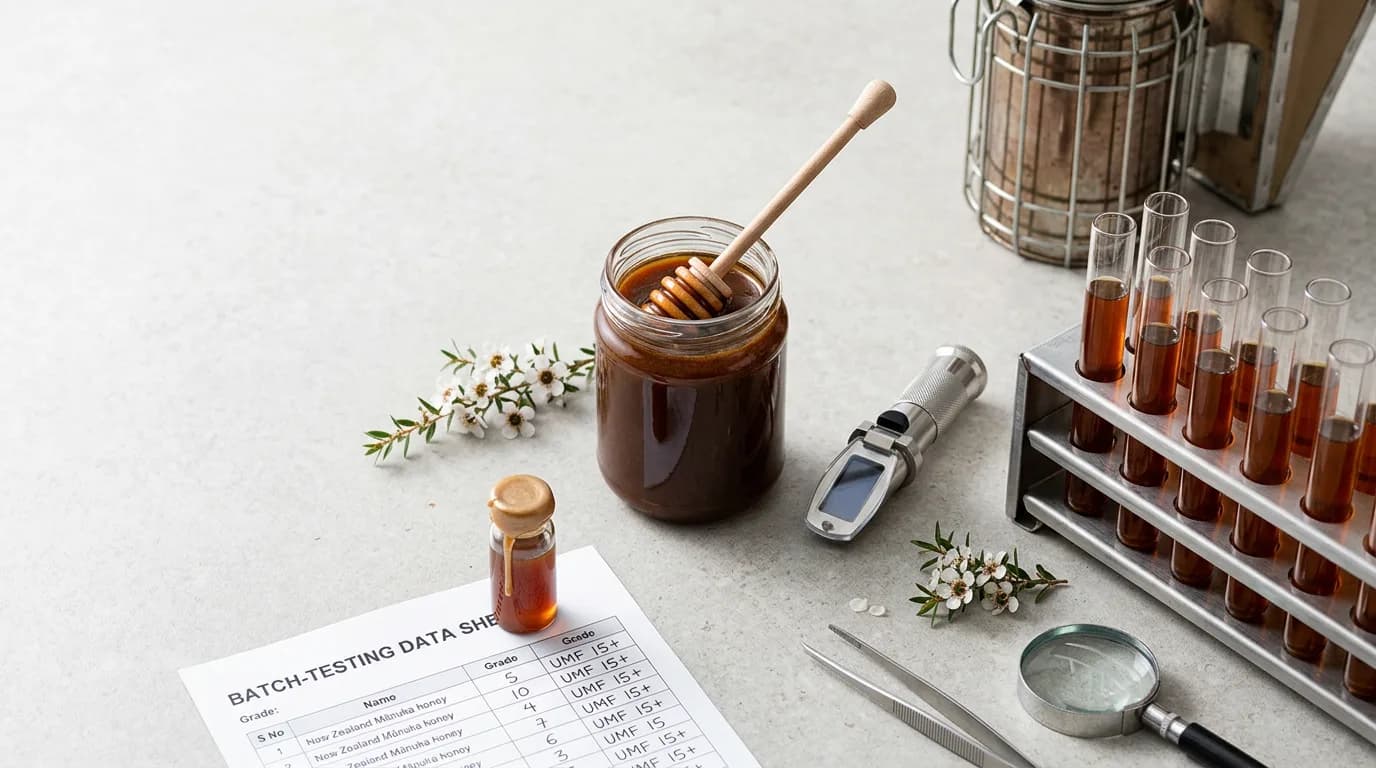
On a label, MGO usually appears as a number followed by a plus sign — for example MGO 400+ — which is the minimum methylglyoxal concentration in milligrams per kilogram. Higher numbers mean more measured non-peroxide activity per gram of honey. The relationship to UMF is approximate but stable: MGO 83+ aligns with UMF 5+, MGO 263+ with UMF 10+, MGO 514+ with UMF 15+, MGO 829+ with UMF 20+, and MGO 1,122+ with UMF 24+.
For most everyday buyers, MGO 263+ to MGO 514+ covers what is typically marketed as "active" Manuka honey, while MGO 829+ and above is the range typically reported in clinical wound-care studies of Manuka honey. Above that, grades such as UMF 26 and UMF 28 are scarce and priced accordingly; the practical question is whether the additional concentration is justified by your intended use, since clinical evidence tends to plateau rather than scale linearly with the number on the jar.
When comparing products, look for an MGO number backed by an accredited laboratory test, a UMF licence number that can be checked against the UMF Honey Association register, or both. Be cautious of words like bio-active, raw, or premium used without a specific MGO or UMF figure — those are marketing terms, not verified potency claims. If you are buying for a clinical or therapeutic purpose, talk to a qualified clinician about the appropriate grade and whether food-grade or medical-grade honey is right for your situation.
Limitations & cautions
MGO concentration on its own is an incomplete signal. A high MGO number does not confirm botanical authenticity — that requires a leptosperin test — and it does not confirm freshness, which is tracked separately via hydroxymethylfurfural (HMF). Laboratory-measured antibacterial activity does not automatically translate into a clinical effect at any specific dose, and MGO values reported by different accredited laboratories can vary depending on assay method and sample handling. Treat MGO as one data point among several, and discuss any therapeutic use with a qualified clinician — particularly during pregnancy, in infants under 12 months (honey is not recommended for that group), or alongside diabetes management.
Frequently asked questions
What is the difference between MGO and UMF grading?
What MGO concentration is considered meaningful?
Can MGO be added to honey artificially?
Does MGO degrade over time?
Why is non-peroxide activity important?
Does a higher MGO number mean better health outcomes?