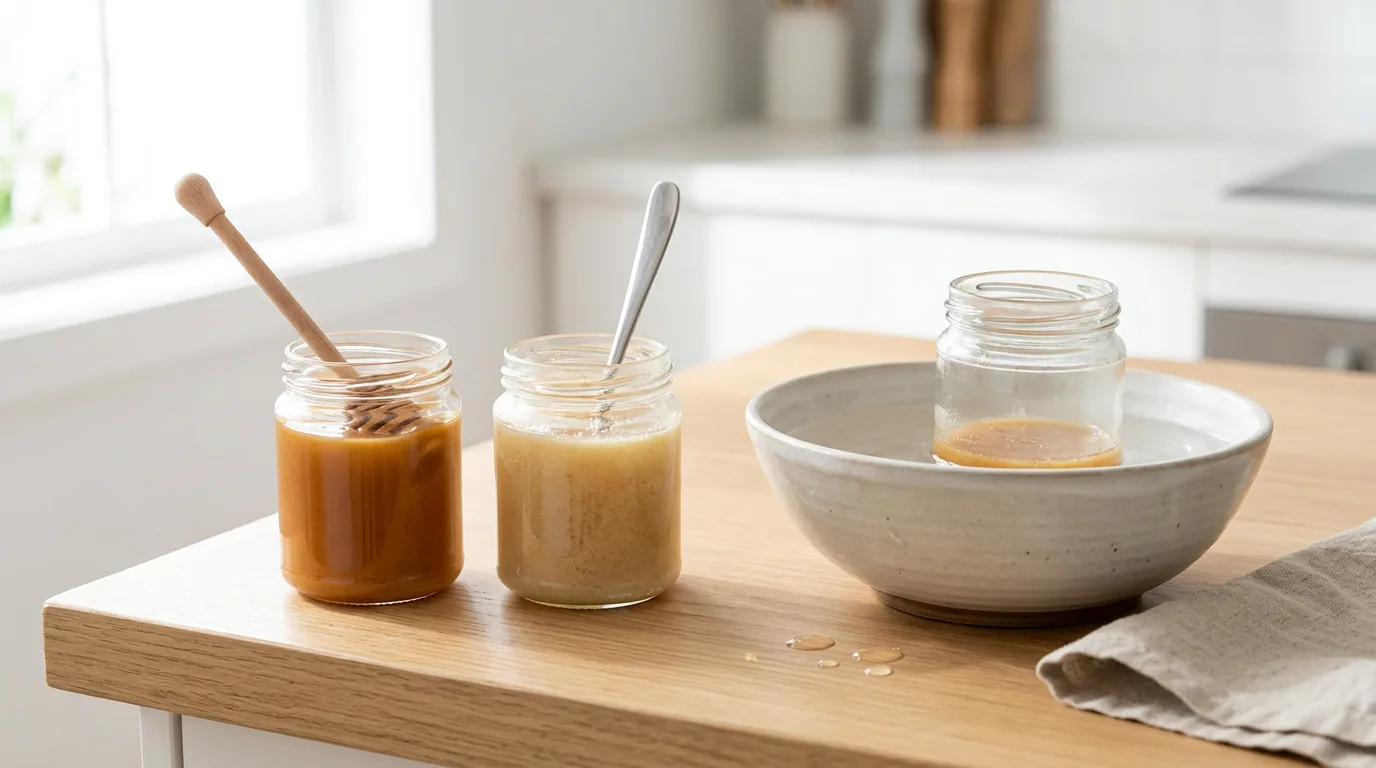
Crystallisation is a natural physical process in which the natural sugars in honey (primarily glucose) separate out of solution and form crystals over time. It happens to raw, unheated honey of all kinds, and manuka honey is no exception — in fact, it's a sign that a jar is behaving the way real honey does.
Why Manuka Honey Crystallises Faster Than Some Others
The speed at which any honey crystallises comes down to its sugar chemistry. Honeys with a higher glucose-to-water ratio, including many monofloral honeys such as manuka, tend to crystallise more readily than some other honey types. This is simply a reflection of the floral source and the natural composition of the nectar the bees collected — it isn't something a beekeeper or brand can fully control, and it isn't unique to any one producer.
Does Crystallisation Mean the Honey Has Gone Off?
No. Crystallisation changes the texture of honey from smooth and pourable to grainy or thick. This is a physical change in the sugar structure and is not, on its own, a sign that the honey has spoiled. A jar that has turned firm, cloudy, or grainy in the cupboard is still the same honey it was the day it was packed — the sugars have simply reorganised themselves. A crystallised jar of honey can generally still be spooned out and used as normal; some people prefer the firmer, spreadable texture, particularly on toast or stirred into porridge where a runnier honey would simply run off.
How to Soften Crystallised Manuka Honey
If you'd rather have your honey back to a liquid, pourable state, gentle heat is the answer. To soften crystallised honey, the jar can be placed in a bowl of warm (not boiling) water and left to sit, stirring occasionally, until it returns to a more liquid consistency. This gradual approach warms the honey evenly without exposing any part of it to excessive heat.
It's worth being careful about how that heat is applied, though. Honey should not be heated directly over a stove flame or brought to a boil, and repeated high-heat exposure should be avoided when softening it, since manuka honey is valued in part for compounds that are best preserved by keeping heat gentle and brief. Using short bursts in a microwave at low power, checked frequently, is another common way people gently warm honey, though a warm water bath tends to give more even, controllable heating, since it warms the jar gradually from the outside rather than in uneven pockets. Either method will bring a crystallised jar back to a pourable state without needing to buy a fresh one.
Storing Manuka Honey to Slow Crystallisation
Where and how a jar is stored has a real effect on how quickly it crystallises. Storing honey at room temperature in a sealed jar, away from direct sunlight, can help slow the rate of crystallisation compared with storing it in a cold environment such as a refrigerator. A cool pantry or cupboard, rather than the fridge, is generally the more practical choice for keeping a jar pourable for longer, and keeping the lid tightly sealed also helps limit the exposure to air and moisture that can accelerate the process.
Does Crystallisation Affect UMF or MGO Grade?
A crystallised jar says nothing about the grading printed on the label. Crystallisation does not indicate a lower grade or lower quality product. A jar's UMF or MGO rating relates to compositional grading and is independent of whether the honey has crystallised. The two things are simply measuring different properties: one is a physical state of the sugars, the other is a laboratory-verified compositional marker, and a UMF 15+ jar that has crystallised in the cupboard is exactly as graded as it was the day it left the lab.
It's also worth knowing that some buyers actually take crystallisation as a reassuring sign rather than a drawback. Some buyers view a crystallised or partially crystallised jar as a sign that a honey has not been heavily processed or ultra-filtered, since aggressive processing can delay crystallisation. Whether or not that matters to you personally, it's a useful reminder that a grainy jar is not a faulty one — it's simply honey behaving as honey does.
If your jar has turned firm or cloudy, there's no need to worry and no need to discard it. A short warm-water bath will restore it to a pourable texture whenever you want it, and in the meantime it can be spooned and used exactly as it was intended.