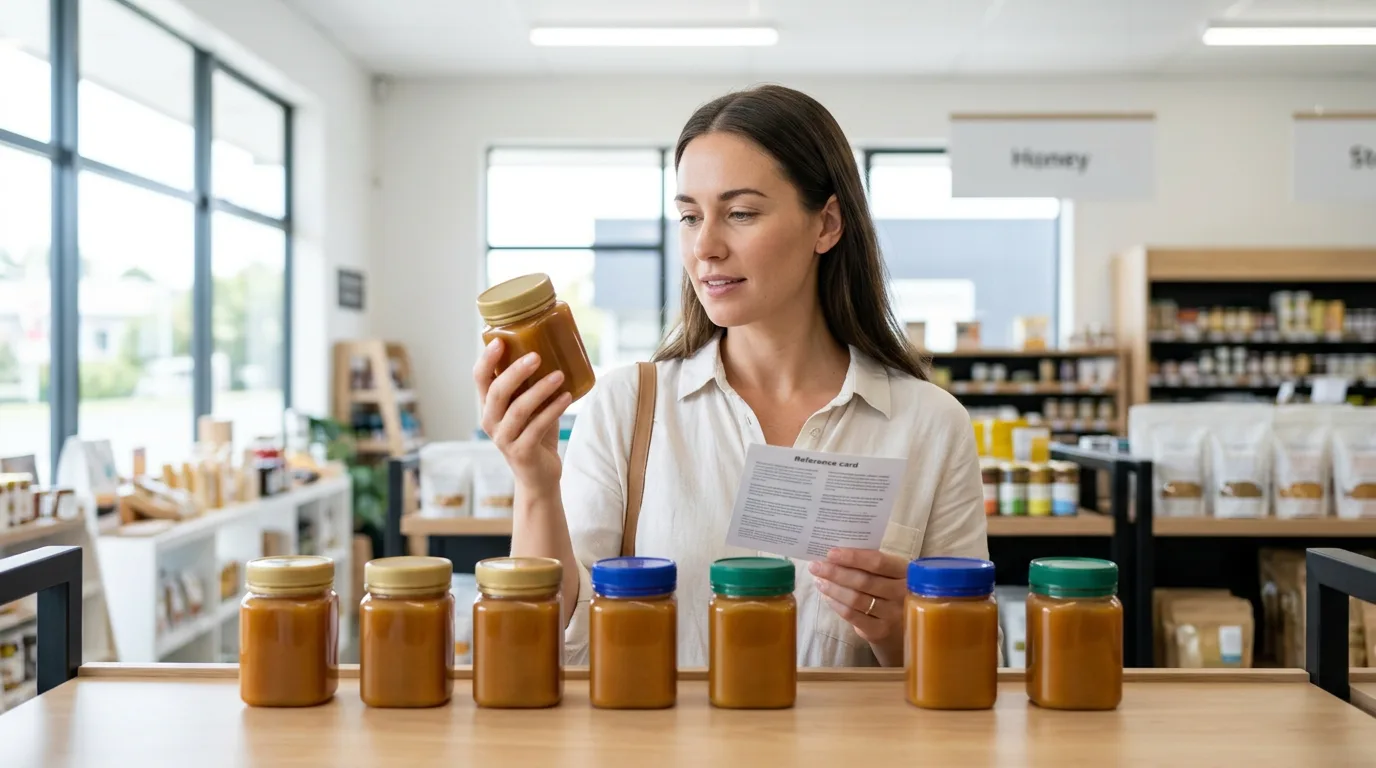
What UMF Actually Measures on a Manuka Honey Label
UMF stands for Unique Manuka Factor, a trademarked New Zealand grading system applied to manuka honey. The UMF rating is calculated from laboratory measurements of specific chemical markers in the honey, including methylglyoxal (MGO), dihydroxyacetone (DHA), and leptosperin.
Together, those three markers give a laboratory a way to confirm, batch by batch, that a jar labelled manuka honey actually contains the chemistry associated with the manuka plant, rather than relying on taste or appearance alone.
What the Number Is Actually Calibrated Against
The UMF grading system is designed to reflect levels of non-peroxide markers as measured by laboratory assay methodology — it is not a measure of taste, colour, or nutritional content, and does not itself indicate an effect on the body. Of the three markers UMF tracks, methylglyoxal has drawn the most research attention, because it is the compound believed to give manuka honey its distinctive non-peroxide antibacterial chemistry. Laboratory research helps explain why: Methylglyoxal, the marker compound behind the UMF rating, has demonstrated in-vitro antimicrobial activity against both free-floating and biofilm-embedded bacteria, with higher concentrations required to act on established biofilms — a laboratory finding, not a clinical one. That is a meaningful piece of chemistry, but it describes what happens in a lab dish, not what a specific UMF number will do for a person eating or applying the honey.
What UMF Doesn't Cover
A UMF number tells you about those three markers and nothing else on the label. UMF certification does not measure or guarantee moisture content, floral purity percentage, or the presence of contaminants unless those are tested separately under other standards. It's worth knowing this distinction, because a high UMF number is a specific, verified claim about marker chemistry — not a general seal of purity or quality across every other attribute of the honey.
Manuka honey is also sold under other grading systems, such as MGO ratings measured directly in mg/kg, which use a different numbering convention than UMF. Both systems are testing related chemistry, but the numbers themselves aren't directly interchangeable, so it's worth checking which system a label is actually using before comparing two jars side by side.
What the Research Says About UMF-Graded Honey
Some of the available research has specifically used UMF-graded honey as its test material, which gives a narrow but useful window into how the graded product performs under study conditions. A small clinical trial in healthy adults found that daily consumption of UMF 20+ manuka honey over four weeks did not trigger an allergic (IgE) response, alter a glycation marker, or disrupt gut bacterial populations — evidence of safety in this specific, limited population, not evidence of a digestive health benefit. That trial involved 20 healthy adults over four weeks, compared against a multiflora honey — a useful, reassuring safety data point, though it doesn't extend to other populations or longer-term use.
More broadly, the grading landscape itself is still an active area of scientific discussion. A recent review of the manuka honey literature notes that grading systems, and the safety and efficacy claims sometimes attached to them, remain a debated and unresolved area of research. That debate concerns how grading relates to broader health claims — it is not a finding that the underlying marker chemistry (MGO, DHA, leptosperin) can't be reliably measured in a lab, which is exactly what a UMF number is designed to certify.
Reading a UMF Label in Practice
Buyers can check a UMF licence number on a label against the UMF Honey Association's public register to confirm the product is licensed to carry that rating. This step matters because the trademark itself is legally protected, but only licensed producers appear on the public register.
Products labelled simply as 'manuka honey' without a UMF or MGO number have not been independently graded for the chemical markers those systems measure. Honey with higher UMF numbers is generally priced higher and marketed as a premium tier compared with lower-graded or ungraded manuka honey. That price gap largely reflects the additional laboratory testing required to verify higher marker levels, batch by batch. Storing manuka honey in a sealed container away from heat and direct sunlight is generally recommended to help preserve its labelled characteristics over time.
Read together, a UMF number is a specific, laboratory-verified statement about three chemical markers in a jar — a concrete, checkable claim that gives buyers a consistent way to compare graded products against each other.