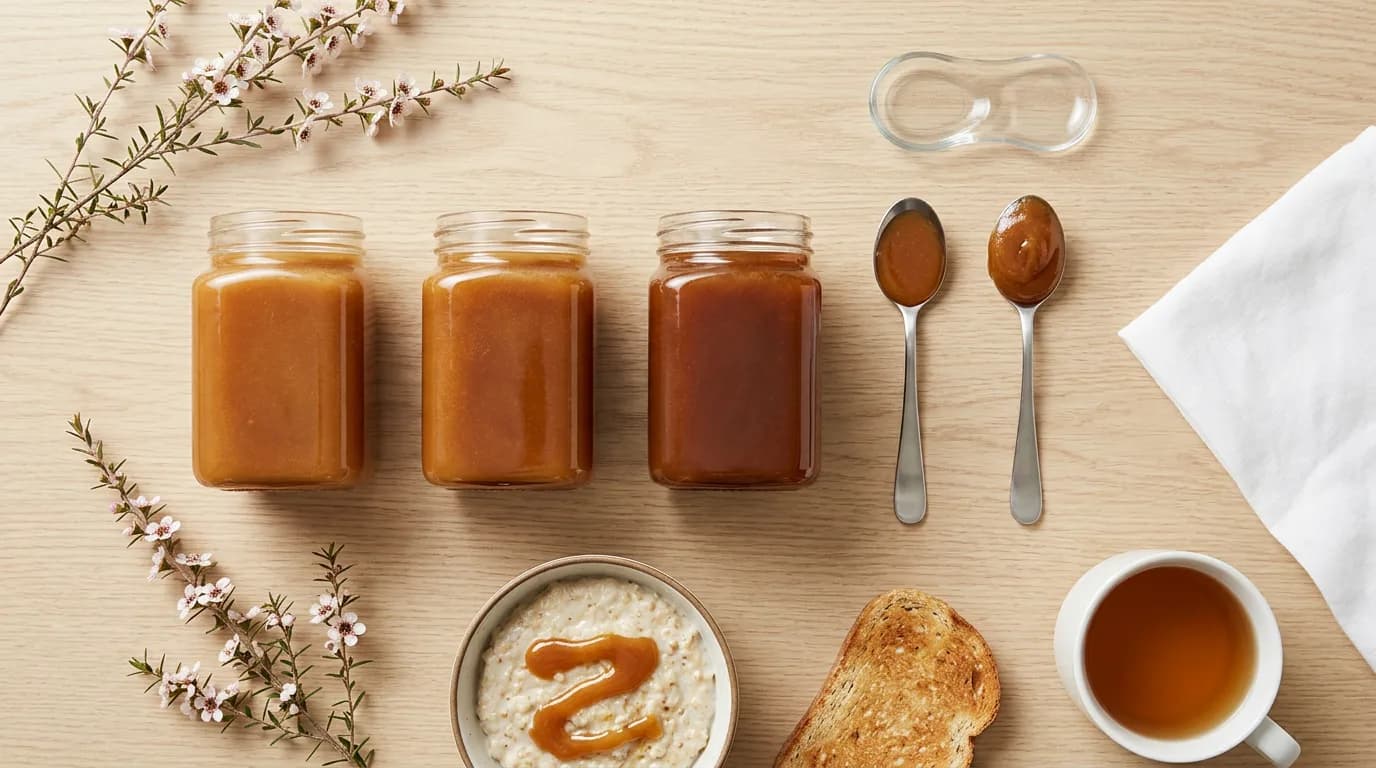
Manuka honey is made by bees foraging on the nectar of Leptospermum scoparium, a shrub that grows in New Zealand and parts of Australia. Serving suggestions on manuka honey labels are set by each brand, and some suggest around 1-2 teaspoons (roughly 7-15 g). This is a description of label practice, not a recommended dose. Check the directions on your own jar.
That label figure is the most practical answer available to the question of daily amount, and it is a useful starting point for planning how manuka honey fits into your day. The sections below cover how to measure a serving, what the one human intake trial did and did not test, and how grading affects what you pay per serving.
Measuring a serving
Honey is dense and sticky, so a heaped spoon can easily hold twice what a level one does. If you use honey, measuring with a level teaspoon rather than a heaped one makes the amount easy to track. Honey counts toward the added sugars in your day.
Honey is also a concentrated sugar food, roughly 80% carbohydrate by weight, which is why serving size matters. A level teaspoon is about 7 g and provides roughly 20 kcal, so larger servings contribute proportionally more sugar and energy to what you eat. People managing blood sugar, including people with diabetes, should speak to a doctor or dietitian about whether and how honey fits their diet.
In practice, many people take one measured teaspoon with tea, stirred into porridge, or spread on toast. A consistent routine makes it simple to see how much you are actually eating.
What a daily-intake trial tested
Daily manuka honey intake has been tested in a randomised, double-blind crossover trial, which gives a useful reference point for what has been studied in healthy adults.
In one small trial (20 healthy adults aged 42-64, 4 weeks), eating 20 g of UMF 20+ manuka honey daily left allergy-related IgE and a marker of glycation (CML) unchanged, which is reassuring for healthy adults eating that amount every day. The study was short and small. It measured these markers only and does not establish a recommended or ideal daily amount.
For scale, the 20 g used in the one intake trial is roughly three level teaspoons, which is more than the serving many labels suggest. It was a trial amount in healthy adults and is not a target.
The trial also looked at the gut: the bacterial groups it tested stayed stable while people ate manuka honey daily for four weeks.
The scope of the trial matters when you read its results. The available intake data come from healthy adults only, using one manufacturer's honey for 4 weeks. The trial did not test infants, children, pregnant women, people with diabetes, or people with honey or pollen allergy, and it did not test amounts above 20 g per day. Its findings should not be extended to these groups.
What you can take from it is that the serving sizes printed on labels sit below the amount healthy adults ate in that trial. The trial is not a dosing guide, and the label is the better reference for everyday use.
Does a higher grade change the amount?
Generally not: most brands suggest the same serving whatever the grade. UMF (Unique Manuka Factor) is a commercial grading scheme that tests honey for several chemical markers, including methylglyoxal (MGO). Some brands instead state MGO directly in mg/kg. The two scales line up: UMF 10+ corresponds to MGO 263+, UMF 15+ to MGO 514+ and UMF 20+ to MGO 829+.
A grade tells you how much MGO the jar is certified to contain. MGO is the compound behind manuka honey's distinctive antibacterial activity in laboratory studies. A grade is not a dosing instruction, so treat any grade-based serving suggestion as general label information.
Grade does change what you pay. Higher UMF or MGO grades are usually priced higher, often substantially. Many brands list the same serving size across grades, so a higher grade generally means a higher cost per serving. Comparing cost per teaspoon across products is one way to see the difference. Price does not indicate a different suggested amount.
When you compare jars, a few checks make the label easier to read. Grade labels vary by brand and certification scheme (UMF-licensed versus MGO-stated). Check which scheme is used, whether the figure is a minimum or a typical value, and whether the jar carries a licence number or batch information.
Storing your honey
Good storage keeps a jar in good condition for as long as you use it. Store manuka honey in a closed jar at room temperature, away from direct sunlight and heat, and use a clean, dry spoon each time.
A practical way to approach it
If you choose to use manuka honey, follow the directions on your own jar, measure with a level teaspoon, and count it among your added sugars. Compare cost per teaspoon across grades so that you pay for the grade you actually want. A measured, consistent serving is easy to track and easy to fit into a normal diet.