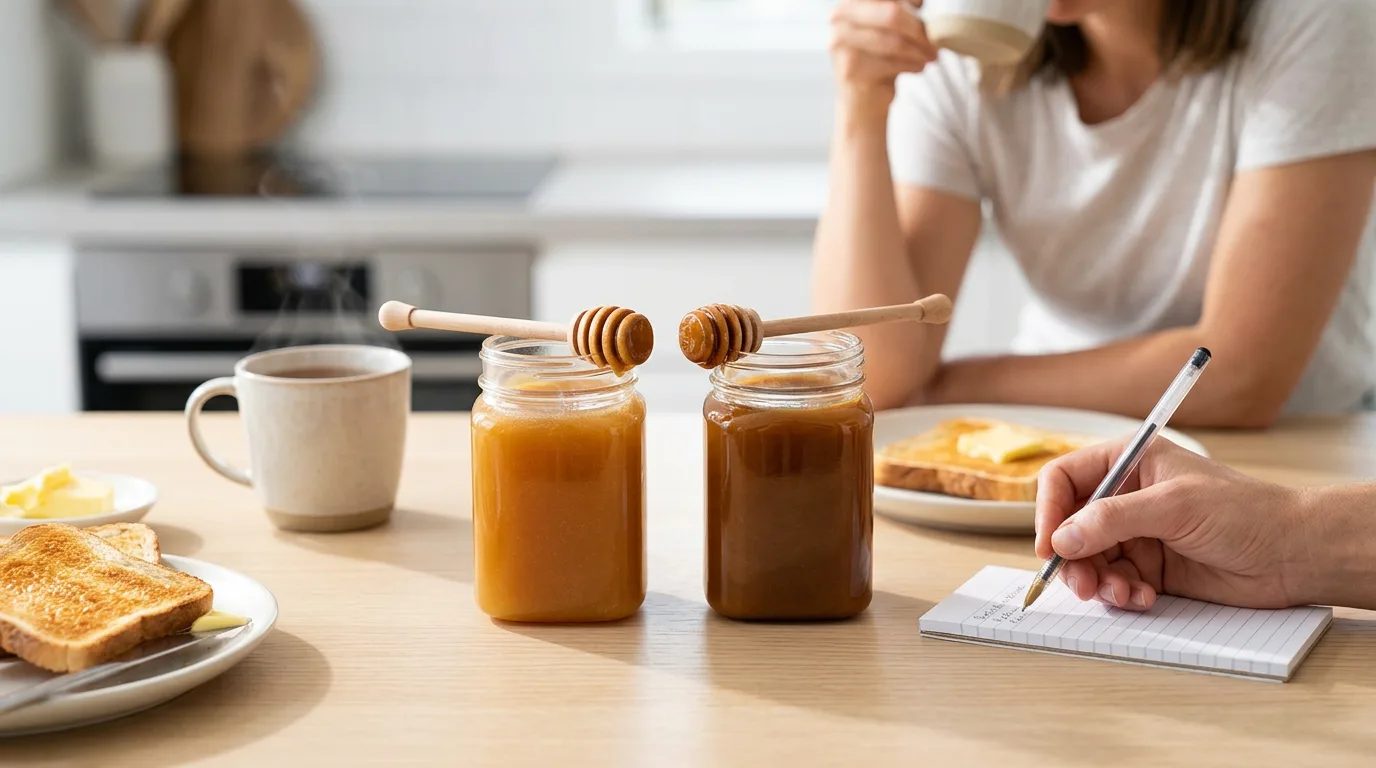
Manuka honey is graded by UMF (Unique Manuka Factor), a system based on independent testing of what's actually inside the jar. For everyday, spoon-in-your-tea use, many buyers choose an entry-level certified grade as an affordable daily jar, and save the top grades — with their higher measured levels of manuka's signature compounds — for more occasional use.
UMF is a grading trademark, licensed by the UMF Honey Association, that certifies the concentration of specific marker compounds, including methylglyoxal, dihydroxyacetone, and leptosperin, in a batch of honey. A higher UMF number on a label indicates a higher measured level of the honey's marker compounds according to that grading scheme, not a different type of honey. In practical terms, a UMF 5+ jar and a UMF 20+ jar both came from manuka blossom and sit in the same category of honey — they simply differ in how concentrated those marker compounds are, as confirmed by testing.
Choosing a Grade for Everyday Use
Some buyers choose lower-UMF honeys (for example, in the UMF 5+ to 10+ range) for everyday table use, and reserve higher-UMF honeys for more occasional use, largely on the basis of cost and personal preference. This everyday-versus-occasional split isn't a scientific rule so much as a practical one: a lower grade generally costs less per jar, and for stirring into tea, spreading on toast, or general daily use, that price difference matters to most households more than reaching for the highest number on the shelf. At every grade you still get manuka's rich, distinctive flavour at the table; an entry-level grade simply makes that an affordable everyday habit, while a top grade carries a higher measured level of its signature compounds.
Higher-UMF jars tend to get marketed toward more occasional or targeted use, such as taking a spoonful on its own rather than stirring it into a hot drink. That's a matter of habit and intended use rather than a rule, and there is nothing about a lower grade that makes it unsuitable for daily use — plenty of people use UMF 5+ or 10+ honey as their everyday jar without ever buying anything higher.
What the Research Says About Grade and Safety
Most research on manuka honey to date has focused on its chemistry and general safety rather than on comparing outcomes across specific UMF grades, and what does exist on daily use is reassuring. A small clinical trial in healthy adults (n=20) found that daily consumption of UMF 20+ manuka honey for four weeks did not raise markers of allergic response or measurably change gut bacteria levels compared with a standard honey. The study was limited to healthy adults over a short period and did not include people with diabetes, pregnant individuals, or those with existing allergies. That trial tested UMF 20+ honey specifically, so its findings apply to that grade rather than to lower grades, which weren't studied — but it is a useful data point for anyone wondering whether eating manuka honey daily raises any obvious concerns in otherwise healthy people.
Grading itself is a genuinely useful, standardised way to compare jars, and the wider research field still has open questions about it. A recent review of manuka honey research describes grading systems, their link to claimed benefits, and safety questions as topics that remain under active scientific discussion. That ongoing discussion concerns how grading connects to specific health claims, not whether testing itself is meaningful — a UMF number still reflects an independently verified level of marker compounds in that batch, whichever number you choose.
Buying with Confidence, at Any Grade
UMF and MGO are two different grading scales used across brands, so a given UMF number and a given MGO number are not directly interchangeable without a conversion reference. If you're comparing jars across brands, it's worth checking which scale is printed on the label before assuming a "20" on one jar means the same thing as a "20" on another. Checking for an independent UMF or MGO certification number, and cross-referencing it against the relevant licensing body's register, can help confirm that a labeled grade matches the seller's claim.
Buyers wanting a lower-cost option for daily use may compare price per gram across UMF grades within the same brand before choosing. Staying within one brand's range also makes it easier to compare grades on a like-for-like basis, since the testing method and labelling conventions stay consistent from jar to jar. For most everyday purposes, a certified lower-UMF honey from a brand that tests and labels its batches gives you a dependable jar for daily use, with higher grades there if and when you want them.
References
- (2010). Demonstrating the safety of manuka honey UMF 20+in a human clinical trial with healthy individuals. The British journal of nutrition. doi:10.1017/s0007114509992777
- (2024). An updated review of functional ingredients of Manuka honey and their value-added innovations. Food chemistry. doi:10.1016/j.foodchem.2023.138060
- (2017). A Comparison of Tissue Engineering Scaffolds Incorporated with Manuka Honey of Varying UMF. BioMed research international. doi:10.1155/2017/4843065