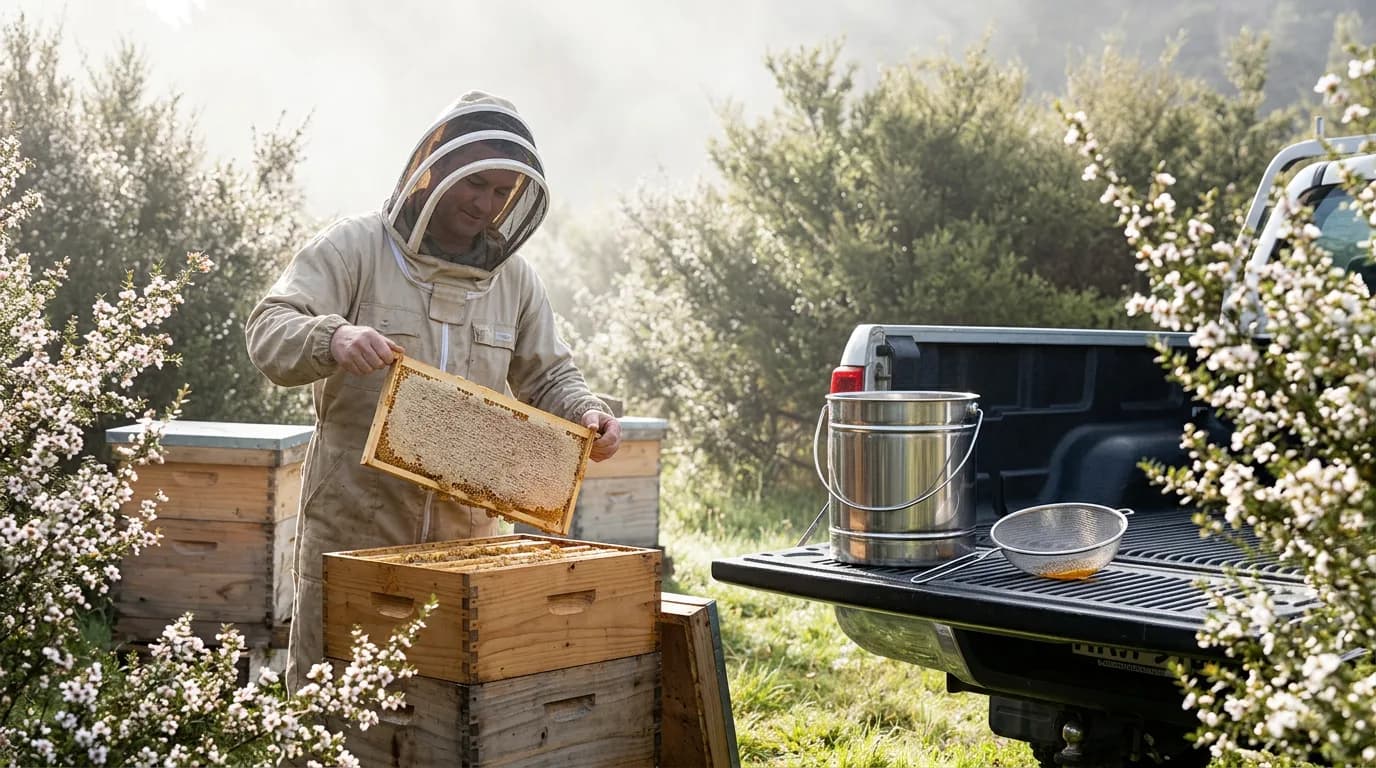
Manuka honey begins with bees foraging on the manuka tree (Leptospermum scoparium), a plant native to New Zealand that produces nectar with a distinctive chemical profile. From there, the honey moves through harvesting, extraction, filtering, and independent laboratory testing before it reaches the grade and batch number printed on a jar.
A Short Flowering Season Sets the Clock
Manuka produces a short, intense flowering period, typically a few weeks in late spring to summer in New Zealand, which limits the window during which bees can forage on it. Because that window is so narrow, timing matters enormously to producers. Beekeepers commonly move hives into or near manuka scrub shortly before flowering begins so that bees forage predominantly on manuka nectar rather than other plants. This positioning is what allows a batch of honey to be predominantly manuka-derived, rather than a blend picked up from a longer, more mixed foraging season.
From Hive to Extraction Facility
After the flowering period ends, frames of capped honeycomb are typically removed from hives and taken to an extraction facility. Extraction commonly involves uncapping the honeycomb and spinning frames in a centrifuge to release the honey, followed by straining to remove wax and debris. What sets manuka honey apart from other honey happens later, during testing and grading, not during extraction itself.
Before bottling, honey is typically settled or lightly filtered to remove air bubbles and fine particulate, then packed into jars. At this stage the honey is ready to eat; the UMF or MGO number that eventually appears on a jar comes later, once laboratory testing is complete.
Verifying What's in the Jar
This is where manuka honey diverges most clearly from other honey types. According to a 2024 scientific review, manuka honey contains characteristic compounds such as methylglyoxal, dihydroxyacetone, and leptosperin, which laboratories use as chemical markers to help verify a batch's manuka origin and grade. Laboratory testing of a honey batch typically checks pollen content and chemical markers to help confirm it derives predominantly from manuka nectar rather than other floral sources.
Grading systems such as UMF (Unique Manuka Factor) or MGO assign a rating to a batch based on measured levels of specific compounds rather than on appearance, colour, or taste alone. In practice, the UMF or MGO number printed on a jar's label is intended to reflect laboratory test results for that specific batch, not a figure chosen by the seller.
What Happens When It's Eaten
Because manuka honey is sold and consumed as a food, its safety when eaten has also been studied directly, separate from the chemistry work above. A small clinical trial in 20 healthy adults found that daily consumption of UMF 20+ manuka honey for four weeks did not raise markers of allergic response (IgE) or alter gut bacterial populations, supporting its safety for healthy individuals in that short-term setting; this was not tested in people with existing allergies, infants, or those with diabetes. That's a narrow but reassuring finding for otherwise healthy adults eating manuka honey as part of a normal diet over a few weeks — it doesn't extend to other populations or to longer-term use, which is one reason the cautions below are worth reading before making dietary changes.
Pricing, Storage, and Checking Authenticity
The work described above — narrow harvest windows, hive relocation, and per-batch lab testing — is reflected in price. Batches with higher UMF or MGO grades are generally priced higher, partly reflecting lower yields of honey meeting those thresholds. Because that premium exists, buyers can look for an independent laboratory test certificate or traceable batch number as one way to check a jar's authenticity before purchase.
Once you have a jar, storage is straightforward. Manuka honey, like other honeys, is best kept in a sealed jar at room temperature and away from direct sunlight to help maintain its consistency and appearance. Taken together, this chain — narrow harvest window, extraction, and independent testing — is what allows a jar with a stated grade to be traced back to a specific, verified batch, which is ultimately what that number on the label is meant to give you.
References
- (2010). Demonstrating the safety of manuka honey UMF 20+in a human clinical trial with healthy individuals. The British journal of nutrition. doi:10.1017/s0007114509992777
- (2024). An updated review of functional ingredients of Manuka honey and their value-added innovations. Food chemistry. doi:10.1016/j.foodchem.2023.138060