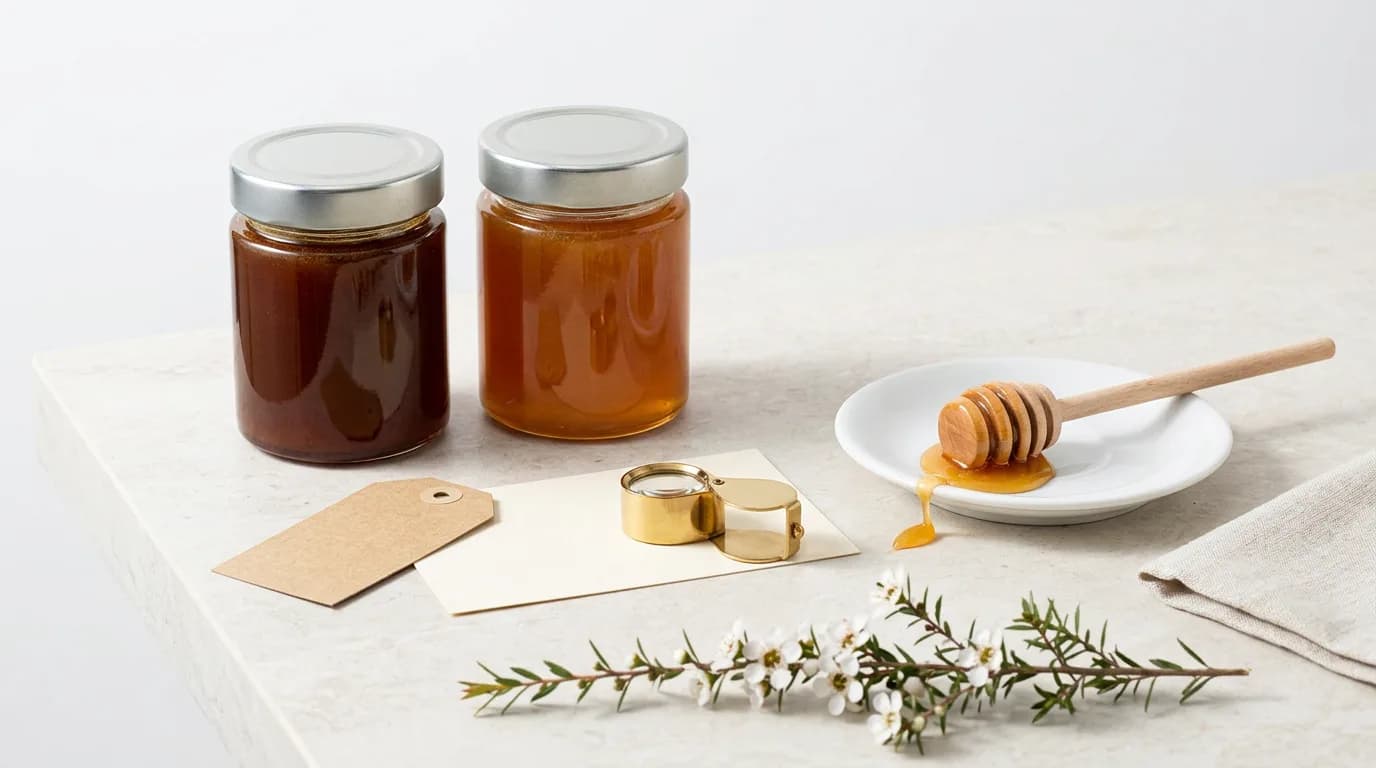
Manuka honey is derived from the nectar of Leptospermum scoparium, a shrub native to New Zealand and parts of Australia. Genuine jars are identified through a combination of chemical grading and traceable licensing, which together make it possible for a buyer to check whether what's in the jar matches what's on the label.
Start With the Grading Marks
UMF (Unique Manuka Factor) and MGO (methylglyoxal) are the two grading scales you'll most often see on manuka honey labels, and both are tied to laboratory testing. An MGO number states the measured methylglyoxal content in mg/kg; UMF is a licensed grading trademark, administered by the UMF Honey Association, that certifies a batch's levels of methylglyoxal, leptosperin and dihydroxyacetone (DHA). That's why genuine UMF-graded honey carries the trademark alongside a license number, and why reputable MGO-graded jars carry a batch number you can trace to a test result. A jar with a grade number but no accompanying trademark, license or batch number is worth a second look.
Researchers note that manuka honey grading, contaminant limits, and marketed health claims remain areas of ongoing debate and inconsistent standardization across the industry. That doesn't mean grading marks are meaningless — UMF and MGO still reflect real, tested chemical thresholds — it means the broader rules around labelling and permissible claims are still maturing internationally, which is one reason a licensed trademark and batch number matter more than a bare number printed on packaging.
Verify the Number, Don't Just Trust It
A license or batch number on a label is only useful if it can be checked. Buyers can check whether a manuka honey's stated license or certification number is currently registered with the trademark-issuing body's public database. This takes a couple of minutes and turns a printed claim into something verifiable rather than something taken on faith.
Reputable manuka honey sellers often provide access to independent, batch-specific laboratory test certificates, sometimes via a QR code or reference number on the jar. If a seller markets a high-grade honey but can't produce a batch-specific test certificate on request, that's a meaningful gap between what's claimed and what's demonstrated.
It also helps to cross-reference the details printed on the jar against what's published elsewhere. Checking that the country of origin, packer details, and batch number on the label match what is listed on the seller's or certifier's website is a simple way to cross-check authenticity. Mismatched packer names, inconsistent batch formats, or a country of origin that doesn't match the certifying body's records are all worth treating as red flags rather than dismissing as clerical error.
Read Price as a Signal, Not Just a Cost
Price is one of the more reliable practical signals available to an ordinary buyer, precisely because genuine manuka honey production is limited and independent testing is costly. Retail prices for manuka honey generally rise with higher stated grades, so a jar priced far below the typical market rate for its claimed grade can be a signal worth investigating. A UMF 20+ jar priced like a UMF 5+ jar hasn't necessarily been mis-graded by accident.
Because single listings can be outliers for legitimate reasons — clearance stock, packaging changes, or a smaller jar size — it helps to check more broadly before drawing conclusions. Comparing prices for the same stated grade and jar size across several established retailers can help buyers spot listings that are priced implausibly low relative to the market. If one listing sits well below every comparable one, that's the listing to scrutinise, not the market average.
Know the Difference Between Manuka and 'Manuka-Type'
Not every jar on a shelf labelled with the word "manuka" is claiming to be certified, single-source manuka honey, and the wording on the label usually says so if you read it closely. Some sellers market blended or 'manuka-type' honeys at a lower price point than single-source, certified manuka honey; label wording such as 'blend' or 'infused with' distinguishes these from certified monofloral manuka honey. These blended products aren't necessarily fraudulent — but they are a different product from certified monofloral manuka honey, and the price and grading expectations that apply to one don't apply to the other. Reading past the word "manuka" on the front of a label to the fine print on the back is often the simplest single check a buyer can make.
Taken together, these checks — a licensed trademark and batch number, a verifiable registration, an available lab certificate, a price that fits the market, and label wording that matches what's actually in the jar — give a buyer a practical way to tell a properly graded manuka honey from something diluted or mislabelled, without needing any specialist equipment of their own.
References
- (2024). An updated review of functional ingredients of Manuka honey and their value-added innovations. Food chemistry. doi:10.1016/j.foodchem.2023.138060
- (2010). Demonstrating the safety of manuka honey UMF 20+in a human clinical trial with healthy individuals. The British journal of nutrition. doi:10.1017/s0007114509992777