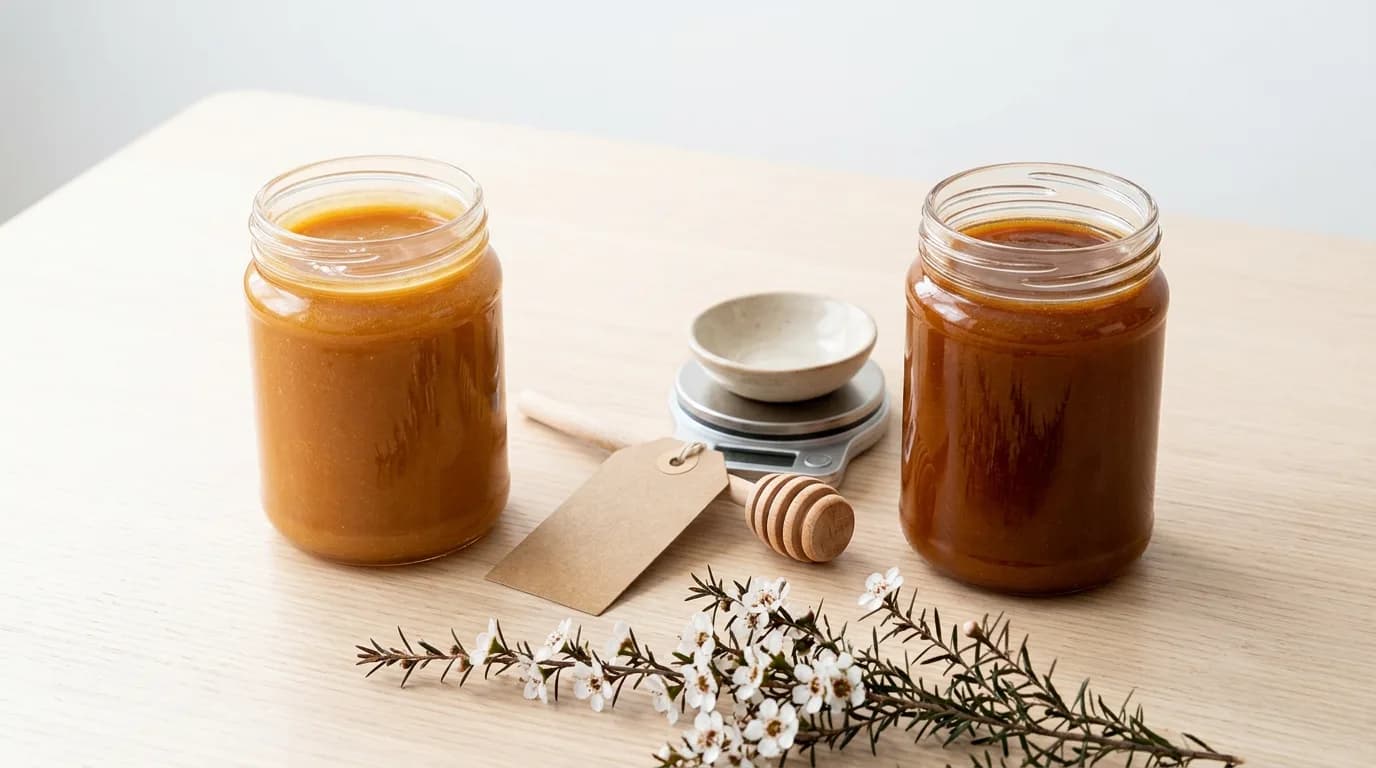
Manuka honey is made by bees foraging on the nectar of the manuka plant (Leptospermum scoparium), which grows in New Zealand and parts of Australia. The step from UMF 10+ to UMF 15+ is a step up in grade: a higher number indicates higher measured levels of the marker compounds the UMF system certifies, and that is what the price difference on the shelf is built around.
What the UMF number is
UMF (Unique Manuka Factor) is a commercial grading system for manuka honey, and the number on the label is the grade. The grade certifies what is in the jar; it describes the honey rather than promising a result for any individual.
One of those markers is methylglyoxal, usually shortened to MGO. UMF grading is described in the research literature as reflecting the methylglyoxal (MGO) concentration of commercial manuka honey.
The practical upshot is that UMF gives buyers a standardised, certified way to rank manuka honeys against one another. A jar carrying a licensed number has been graded, and the number gives you a common reference point.
UMF 10+ vs UMF 15+ at a glance
UMF 10+ and UMF 15+ are two grades commonly seen on shelves. A buyer choosing between them is comparing two graded products.
| UMF 10+ | UMF 15+ | |
|---|---|---|
| Grade level | Lower certified grade | Higher certified grade |
| MGO equivalent | MGO 263+ mg/kg | MGO 514+ mg/kg |
| What the number indicates | Lower measured levels of the certified marker compounds | Higher measured levels of the certified marker compounds |
| Typical price | Usually lower | Usually higher |
| What to check on the label | UMF number, licensee or brand details, batch or traceability code | UMF number, licensee or brand details, batch or traceability code |
The label checks are identical for both grades. A higher number does not replace them, and a lower number does not exempt a jar from them.
The price step
Higher UMF grades are usually priced higher than lower grades from the same brand. The size of the price step varies by brand, retailer and season, so price per gram is the clearest way to see what each jar actually costs.
To work out the price per gram, divide the shelf price by the jar weight in grams. Do this for both jars, and ideally for the same brand, so that you see the actual cost of the step from 10+ to 15+ rather than a headline price. A larger jar of UMF 10+ can cost less per gram than a small jar of the same honey, and the same goes for UMF 15+.
How UMF and MGO line up
Many jars show an MGO value instead of, or alongside, a UMF grade. MGO is stated in mg/kg, and the two scales correspond: UMF 10+ matches MGO 263+ and UMF 15+ matches MGO 514+. The step from UMF 10+ to UMF 15+ therefore roughly doubles the minimum MGO certified in the jar.
If you are comparing a UMF jar with an MGO jar, convert with these figures first, then compare price per gram. A jar labelled MGO 250+, for example, sits just below UMF 10+.
Reading the label with confidence
When comparing products, look for a UMF number on the label together with licensee or brand details and a batch or traceability code. The UMF Honey Association website is the place to check licensee information.
These three details, the number, the licensee and the batch code, are what turn a claim on a jar into something you can trace. A jar that shows all three is easy to compare with another and easy to verify.
Storing your jar
Manufacturers generally advise storing honey in a sealed container at room temperature, away from direct sunlight and heat, and using a clean, dry spoon. Follow the storage instructions printed on the jar. This applies to food-grade honey only and is not guidance on medical products.
Choosing between UMF 10+ and UMF 15+
UMF 15+ is the higher certified grade, with roughly twice the minimum MGO of UMF 10+. Both are graded manuka honeys, and both can be checked against a licence. A sensible way to choose is to:
- Confirm the jar shows a UMF number, licensee details and a batch code.
- Check which scale (UMF or MGO) each product uses, and convert MGO figures to their UMF equivalent.
- Work out the price per gram for each jar.
- Choose UMF 15+ for the higher certified MGO level, or UMF 10+ for everyday use at a lower price per gram.
Following those four steps lets you compare like with like and pay for the grade you actually want.