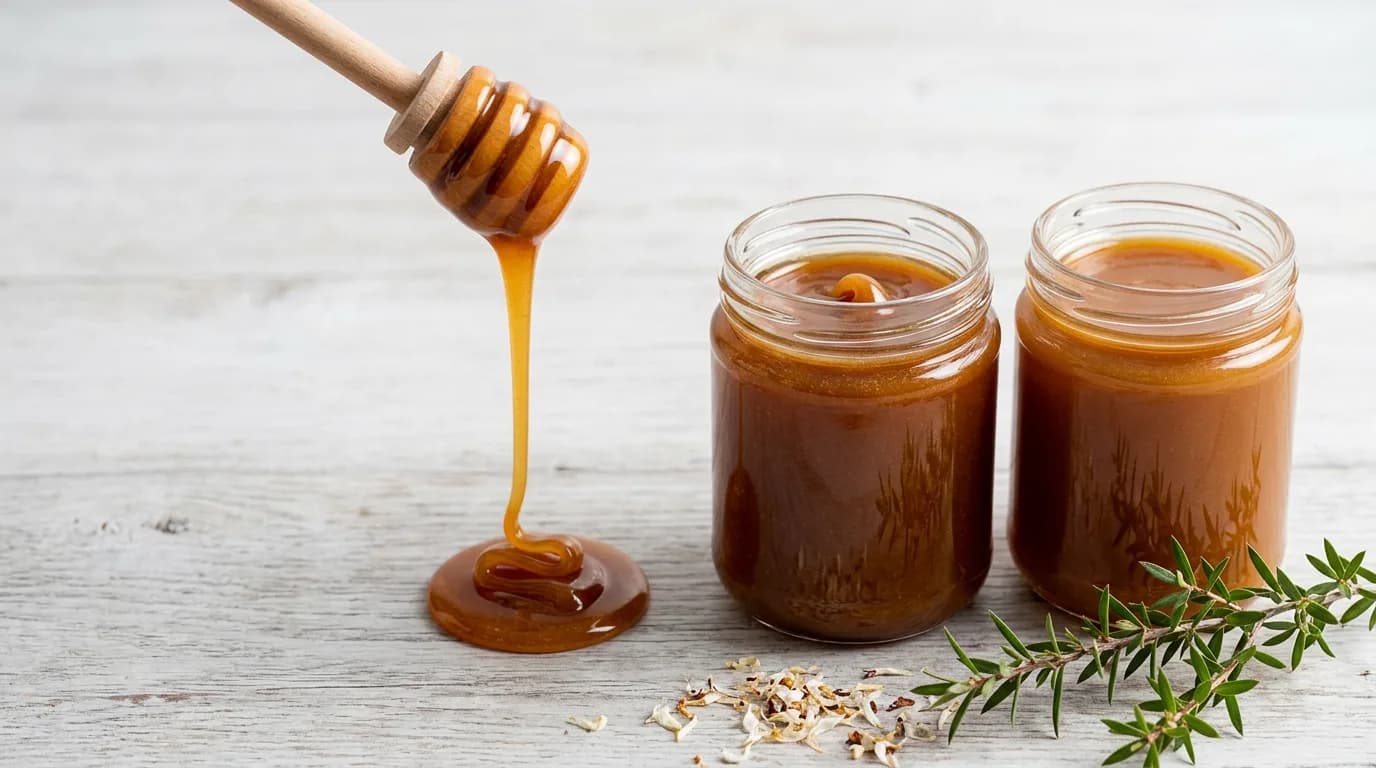
Manuka honey is commonly described as thixotropic: thick and gel-like at rest, and more free-flowing after stirring. Some other honeys, such as heather (ling) honey, are described in the same way.
That behaviour is the reason a jar of manuka honey can seem almost set when you open it, yet loosen up once you work a spoon through it. Understanding the term makes it easier to handle the honey and to read what labels and grades do and do not tell you.
What "thixotropic" means
A thixotropic material becomes less viscous the longer it is stirred, shaken or otherwise sheared, and then gradually thickens again when left undisturbed.
Two parts of that definition matter:
- The change builds up with time. The longer the honey is worked, the thinner it becomes.
- The change reverses. Left alone, the honey gradually thickens again, so stirring does not permanently alter it.
Viscosity here simply means resistance to flow. A thick, gel-like honey has high viscosity at rest. After stirring, the same honey has lower viscosity and pours or spreads more easily.
Thixotropy is not the same as shear-thinning
The two terms are often used interchangeably, but they describe different things. Thixotropy is a time-dependent flow behaviour. This sets it apart from simple shear-thinning, where viscosity drops as the shear rate rises but does not depend on how long the shear has been applied.
A simple way to hold the distinction:
| Behaviour | What drives the drop in viscosity | Does duration of stirring matter? |
|---|---|---|
| Shear-thinning | How fast the material is sheared (shear rate) | No |
| Thixotropy | Shearing, building up over time | Yes, and viscosity recovers gradually at rest |
When manuka honey is called thixotropic, the word carries that extra time element: how long the honey has been stirred, and how long it has rested since, both matter.
Using it in practice
The practical side is simple. Stirring manuka honey briefly before spooning or pouring will usually make it flow more easily. It will then thicken again if left undisturbed.
A few ways to make use of that:
- Stir the jar before you serve. A short stir loosens the honey so it comes off the spoon more cleanly.
- Expect it to firm up again. Honey that has set back to a thick gel after sitting has not gone off or changed. It has simply recovered.
- Work it a little longer if it is very stiff. Because the effect builds with stirring time, a bit more stirring generally means easier flow.
Where grading fits in
Thixotropy is a physical flow property. Grading is about something else entirely. UMF is a grading system based on marker compounds in manuka honey. It is not a measure of viscosity or thixotropy.
UMF certifies methylglyoxal (MGO) together with markers that confirm genuine manuka (leptosperin and DHA), while an MGO grade states methylglyoxal alone. The two overlap rather than being identical, and you can compare a UMF grade with an MGO figure using these equivalences:
| UMF grade | Minimum MGO |
|---|---|
| UMF 5+ | MGO 83+ mg/kg |
| UMF 10+ | MGO 263+ mg/kg |
| UMF 15+ | MGO 514+ mg/kg |
| UMF 20+ | MGO 829+ mg/kg |
| UMF 24+ | MGO 1122+ mg/kg |
| UMF 26+ | MGO 1282+ mg/kg |
| UMF 28+ | MGO 1450+ mg/kg |
A higher grade means more certified MGO. The grade tells you about the honey's marker compounds and authenticity, and the stirring behaviour described above is a separate matter.
Thixotropy and price
Thixotropy is not a recognised grading or pricing factor for manuka honey. Grade and price are generally driven by marker-compound testing such as UMF or MGO ratings, and by provenance.
That gives you a clear way to shop. Choose by the grade on the label (for example MGO 263+ (UMF 10+) or MGO 514+ (UMF 15+)) and by the provenance and batch information the brand provides. A honey that is very stiff in the jar is not thereby a higher or lower grade, and a runnier one is not either.
What you can take from this
The thick, gel-like set of manuka honey and its easy flow after stirring are two sides of one reversible property. Stir briefly before you spoon or pour, let it settle back as it will, and use the grade on the label, not the texture, to judge what you are buying.