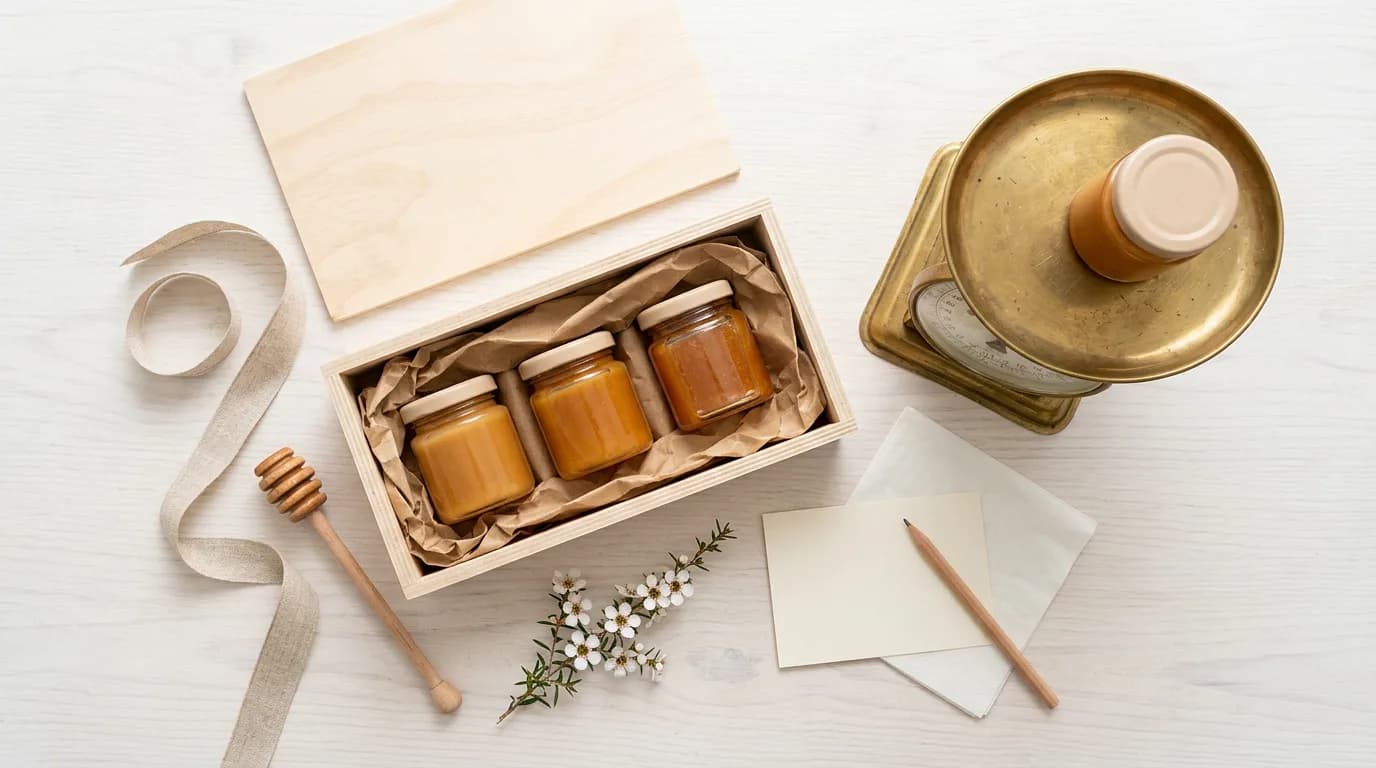
Manuka honey is made by bees foraging on the flowers of Leptospermum scoparium (manuka), a shrub native to New Zealand and also found in parts of south-eastern Australia. A good gift set shows its grade, origin and batch on the label, and those details let you judge what you are paying for.
Why manuka honey makes a distinctive gift
Manuka honey has a following that goes beyond taste. In laboratory conditions, manuka honey showed stronger bacterial growth inhibition than kanuka or clover honey. The study tested four bacterial species in a dish, not in people, and the response varied by organism. That lab work is part of why manuka honey carries a reputation that ordinary table honey does not, and why a clear grade on the jar matters when you choose a set.
Start with the grade
UMF (Unique Manuka Factor) is a commercial grading system for manuka honey, and its numbers are based on measured marker compounds, including methylglyoxal. MGO ratings are a separate numbering scale, so UMF and MGO numbers on different jars are not directly interchangeable without a conversion chart. Here is the chart:
| Grade as labelled on this site | Minimum MGO |
|---|---|
| MGO 83+ (UMF 5+) | 83 mg/kg |
| MGO 263+ (UMF 10+) | 263 mg/kg |
| MGO 514+ (UMF 15+) | 514 mg/kg |
| MGO 829+ (UMF 20+) | 829 mg/kg |
| MGO 1122+ (UMF 24+) | 1122 mg/kg |
| MGO 1282+ (UMF 26+) | 1282 mg/kg |
| MGO 1450+ (UMF 28+) | 1450 mg/kg |
UMF certifies methylglyoxal together with markers that confirm genuine manuka (leptosperin and DHA), while an MGO grade states methylglyoxal alone. The two overlap rather than being identical, and the table lets you compare a UMF jar with an MGO jar directly. A higher grade means more certified MGO, so the number on the jar tells you something concrete.
Gift sets often combine several small jars at different grades. Check each jar's grade individually rather than relying on a single figure on the box.
Check the 'monofloral' or 'multifloral' wording
Labels may describe manuka honey as 'monofloral' or 'multifloral'. These terms describe how much of the honey comes from manuka nectar, so it is worth checking which one a gift-set label states. A set that names the term clearly is giving you information you can act on.
The label checklist
When choosing a gift set, check the label for:
- A stated grade, using the table above to compare UMF and MGO figures
- Country of origin, so you know where the honey came from
- Packer or brand, so there is a name behind the jar
- Batch or lot number, which lets the brand trace the honey
- A best-before date that leaves the recipient time to enjoy it
A set that carries all five gives you the full picture before you buy.
Presentation and price: what you are paying for
Part of a gift set's price may reflect presentation (box, ribbon, accessories such as a honey dipper) rather than the honey itself. Comparing the grade and weight of a set's jar with a standalone jar from the same brand shows how much extra is being charged for packaging. Some buyers are happy to pay for a beautiful box, and the comparison lets you decide that knowingly.
Price generally rises with the stated grade, so compare price per gram rather than price per set. A set of several small jars of different grades can cost more per gram than a single larger jar.
A higher grade number does not by itself make a set better value. Buyers can compare grades, weights and price per gram, and set a budget before choosing. Setting the budget first keeps the decision simple.
Packaging and storage
For gifting, check that the jar lids have tamper-evident seals, that glass jars are cushioned in the box, and that any included spoons or dippers are clean and packed separately from the honey. These checks take a minute and protect the gift in transit.
Honey is best stored in a sealed jar in a cool, dry place out of direct sunlight. For gift sets that have been stored for a long time or shipped in warm conditions, check that the seals and packaging are intact. If you are sending a set in summer, choose a delivery window that avoids long waits in a hot vehicle or porch.
Thinking about the recipient
A small randomised crossover trial in 20 healthy adults found no change in IgE, a glycation marker or the gut bacteria measured after 4 weeks of daily manuka honey, so this one honey appeared tolerated in that group. It did not study people with diabetes, pregnant women, people with known honey or pollen allergy, or infants, and it found no health benefit in healthy participants. The finding does not show safety for everyone. Knowing your recipient is therefore part of choosing well.
Honey should not be given to babies under 12 months old. If the recipient's household includes a baby, consider repeating this on the gift note or card. A short line on the card is a thoughtful touch and costs nothing.
The short version
Choose a set whose jars each state a grade, whose label names the origin, packer, batch and best-before date, and whose price per gram holds up against a standalone jar from the same brand. With those checks done, you can give a gift that you can explain and that the recipient can look up for themselves.
References
- (2013). The effect of New Zealand kanuka, manuka and clover honeys on bacterial growth dynamics and cellular morphology varies according to the species. PloS one. doi:10.1371/journal.pone.0055898
- (2010). Demonstrating the safety of manuka honey UMF 20+in a human clinical trial with healthy individuals. The British journal of nutrition. doi:10.1017/s0007114509992777
- (2024). An updated review of functional ingredients of Manuka honey and their value-added innovations. Food chemistry. doi:10.1016/j.foodchem.2023.138060
- (2010). Comparison of the antimicrobial activity of Ulmo honey from Chile and Manuka honey against methicillin-resistant Staphylococcus aureus, Escherichia coli and Pseudomonas aeruginosa. BMC complementary and alternative medicine. doi:10.1186/1472-6882-10-47