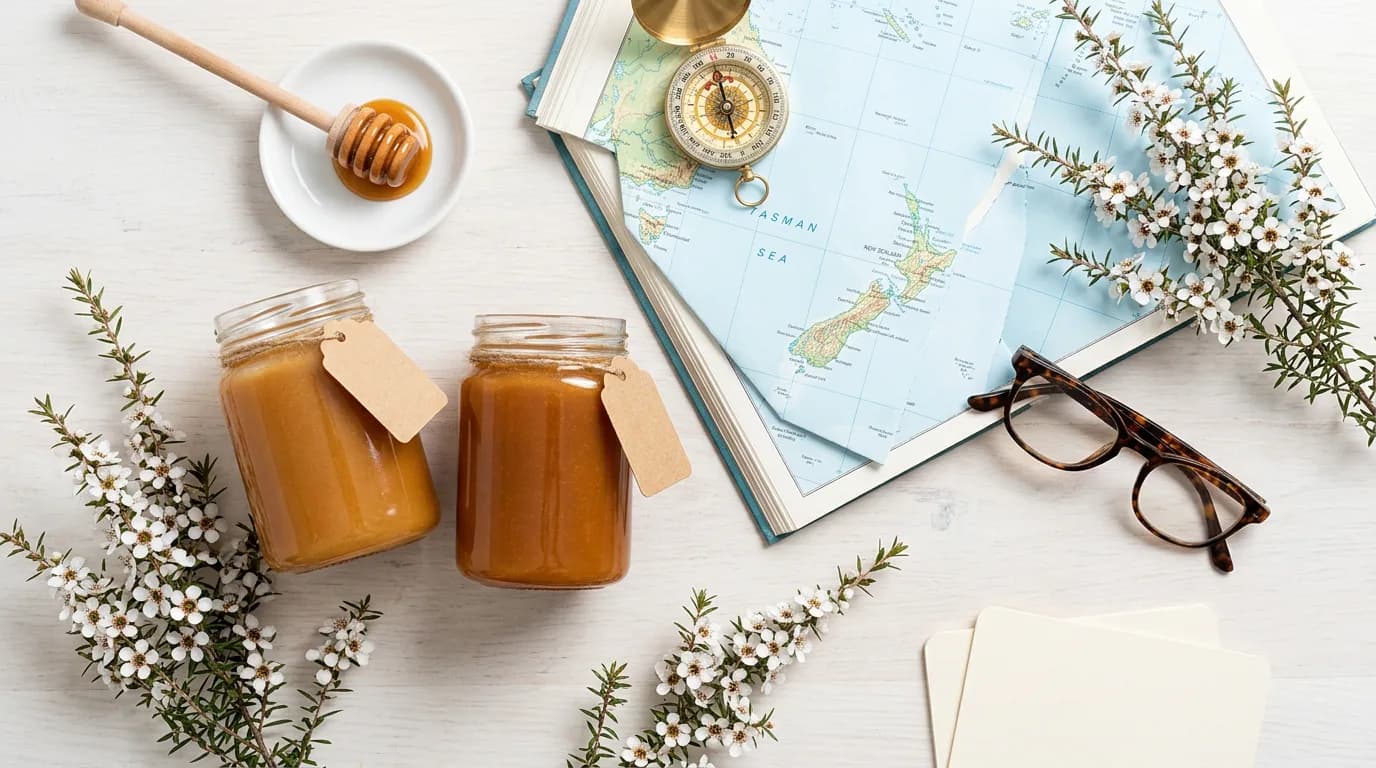
Manuka honey is made by bees foraging largely on Leptospermum scoparium. The plant grows in New Zealand and in parts of south-eastern Australia, where other Leptospermum species also occur. For a shopper, the practical difference between New Zealand and Australian jars comes down to origin, how the honey is defined, and which grading scheme appears on the label.
One plant, two countries
Both countries produce honey from Leptospermum flowers, so the starting point is shared. What differs is the regulatory and labelling context around the finished product.
New Zealand has a formal export definition. New Zealand's Ministry for Primary Industries defines monofloral and multifloral manuka honey for export using a set of chemical markers and a DNA marker. Honey exported from New Zealand as manuka must meet that definition. That gives New Zealand jars a clear, government-backed baseline before any brand grading is applied.
How the grades work
UMF (Unique Manuka Factor) is a grading and trademark system administered by the UMF Honey Association, and its grade is linked to methylglyoxal content. MGO labels, by contrast, state methylglyoxal concentration directly in mg/kg.
The two overlap rather than being identical. UMF certifies methylglyoxal (MGO) together with markers that confirm genuine manuka (leptosperin and DHA), while an MGO grade states methylglyoxal alone. You can compare a UMF grade with an MGO figure using the equivalences below, and a higher grade means more certified MGO.
| UMF grade | Minimum MGO (mg/kg) | Label used on this site |
|---|---|---|
| UMF 5+ | 83+ | MGO 83+ (UMF 5+) |
| UMF 10+ | 263+ | MGO 263+ (UMF 10+) |
| UMF 15+ | 514+ | MGO 514+ (UMF 15+) |
| UMF 20+ | 829+ | MGO 829+ (UMF 20+) |
| UMF 24+ | 1122+ | MGO 1122+ (UMF 24+) |
| UMF 26+ | 1282+ | MGO 1282+ (UMF 26+) |
| UMF 28+ | 1450+ | MGO 1450+ (UMF 28+) |
When you compare a New Zealand jar with an Australian one, the same logic applies. Australian and New Zealand honeys may use different grading and labelling schemes, so a number on one brand's label is not automatically comparable to a number on another's. Check which test or scale is being quoted (UMF, MGO or another). Once you know the scale, the table above lets you line up a UMF grade against an MGO figure.
What the laboratory research covers
Manuka honey's chemistry is the reason it is studied at all. Narrative reviews describe manuka honey as containing methylglyoxal and other bioactive compounds, with antimicrobial and antioxidant activity reported mainly in laboratory studies. Reviews of this kind do not establish clinical benefit. Beyond methylglyoxal, the honey's character comes from compounds such as dihydroxyacetone, leptosperin and phenolics.
Some of the more specific laboratory work used well-characterised New Zealand honeys with known geographic origin and floral source. In comparisons of this kind, the results favoured manuka. In laboratory conditions, New Zealand manuka honey generally inhibited bacterial growth more strongly than kanuka or clover honey. The pattern varied by bacterial species, and these were in-vitro findings only. The study did not compare New Zealand and Australian honeys.
A separate set of experiments looked at bacterial biofilms, which are the protective films bacteria form on surfaces. In laboratory tests, well-characterised New Zealand manuka-type honeys were more active against Staphylococcus aureus biofilms than clover honey or sugar solution, and methylglyoxal on its own did not reproduce the effect. These findings come from in-vitro work and do not show that the honey works as a clinical treatment. The result does point to the whole honey, not one compound, as the thing worth studying.
On the human side, the best-documented question is safety in healthy adults, and the honey tested was graded UMF 20+ (a minimum of MGO 829+ mg/kg). In one small randomised cross-over trial of 20 healthy adults, the amount of UMF 20+ manuka honey given to participants over four weeks did not change IgE levels, a glycation marker or the gut bacteria measured. The trial used honey from one New Zealand producer and does not compare New Zealand with Australian honey. This describes what the trial tested and is not a suggested amount to eat. The authors concluded that eating the honey was safe for healthy people.
The studies above all used New Zealand honey, so the useful comparison for a buyer is the one the label allows: stated origin, stated scale, stated grade.
A buying checklist for either origin
When buying, check the country of origin, the batch or traceability code, the stated grading scheme, and whether the producer or brand is licensed by the relevant grading body.
- Origin: the label should say where the honey was produced.
- Scale: note whether the number is UMF, MGO or something else, then use the equivalence table to compare.
- Traceability: a batch code lets the brand link your jar to its test results.
- Licence: a licensed grading mark shows the producer has agreed to that body's testing.
Keeping it well
Store manuka honey in a sealed jar at room temperature, away from direct heat and sunlight, or follow the storage instructions on the label. Treated this way, a jar will keep its character for a long time.
What you gain
With a few checks, you can compare any two jars, whether from New Zealand or Australia, on the same footing. Read the origin, identify the scale, convert UMF and MGO using the table, and look for a batch code and a licensed mark. A clear label from a traceable producer lets you choose on facts.
References
- (2010). Demonstrating the safety of manuka honey UMF 20+in a human clinical trial with healthy individuals. The British journal of nutrition. doi:10.1017/s0007114509992777
- (2017). A Comparison of Tissue Engineering Scaffolds Incorporated with Manuka Honey of Varying UMF. BioMed research international. doi:10.1155/2017/4843065
- (2013). The effect of New Zealand kanuka, manuka and clover honeys on bacterial growth dynamics and cellular morphology varies according to the species. PloS one. doi:10.1371/journal.pone.0055898
- (2014). Manuka-type honeys can eradicate biofilms produced by Staphylococcus aureus strains with different biofilm-forming abilities. PeerJ. doi:10.7717/peerj.326
- (2024). An updated review of functional ingredients of Manuka honey and their value-added innovations. Food chemistry. doi:10.1016/j.foodchem.2023.138060
- (2014). The Composition and Biological Activity of Honey: A Focus on Manuka Honey. Foods (Basel, Switzerland). doi:10.3390/foods3030420