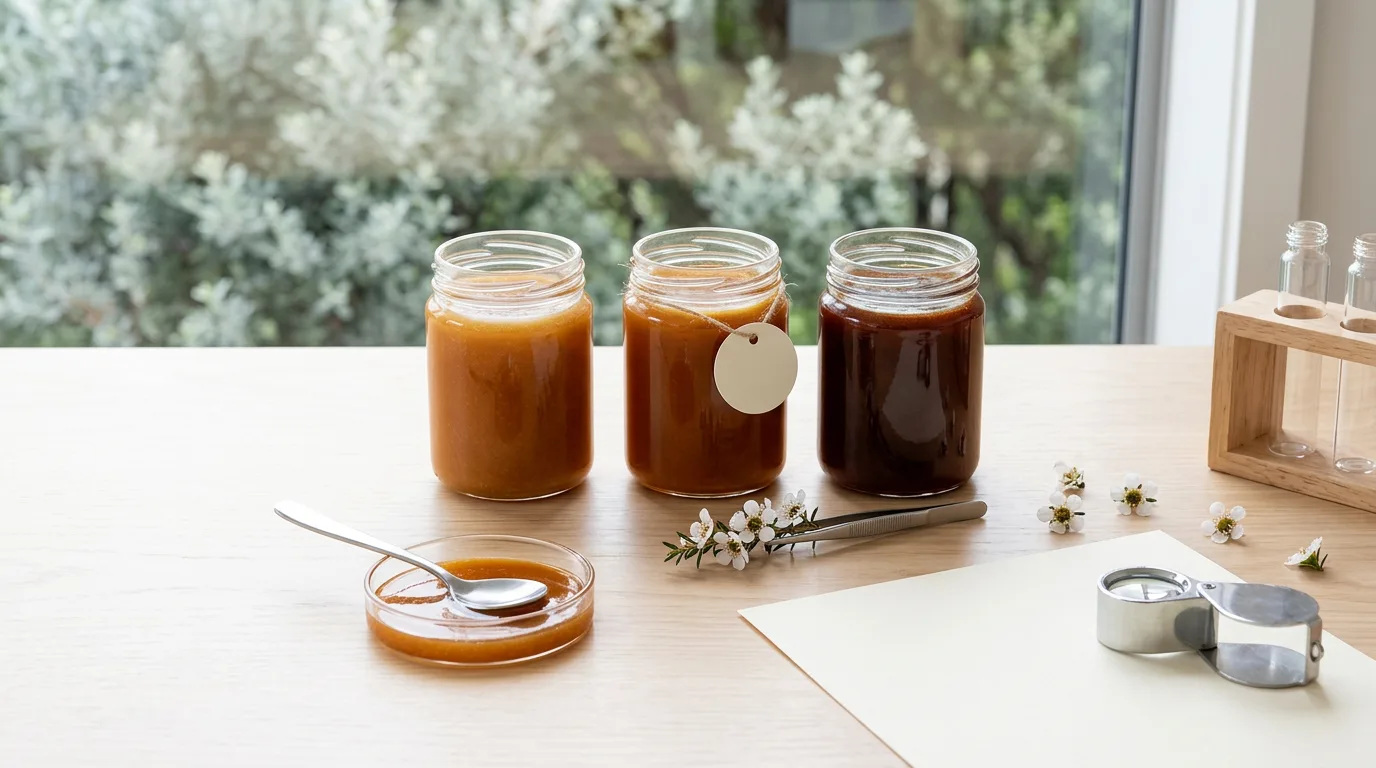
Leptosperin is a naturally occurring compound, a glycoside of methyl syringate, found in honey made from Leptospermum nectar, including manuka. Laboratories measure it as a chemical marker, and it is one of the main tools used to confirm that a jar of manuka honey is what the label says it is.
What leptosperin is
Leptosperin belongs to the family of compounds that come from the Leptospermum plant, the genus that includes the manuka tree. Bees carry the nectar back to the hive, and the compound ends up in the finished honey. Because it comes from that nectar source, a laboratory can look for it and use it as a signal of botanical origin.
In practice, leptosperin is a line on a laboratory report. It is measured alongside other compounds so that the result says something about where the honey came from.
Why it gets tested: authenticity
Leptosperin is tested because it works as an authenticity marker. An authenticity marker is a compound or signal measured to help show that a honey comes from the plant source named on the label. It is a statement about origin, not about how the honey performs.
That distinction matters when you read a label. A leptosperin result helps answer the question "is this really manuka honey?" Other measurements answer different questions, such as how much of a particular compound a batch contains.
Manuka honey is a premium-priced product, which gives producers and regulators a reason to verify origin with laboratory methods rather than by taste or appearance alone. A marker that comes from the right nectar source gives them something concrete to measure.
Why more than one marker is used
Methylglyoxal (MGO) is a single compound that is also used for grading. Testing several markers together, including leptosperin, gives a fuller picture of a honey's origin than one compound alone.
This is the reasoning behind the main grading scheme. The UMF grading scheme, run by the UMF Honey Association, tests for leptosperin together with MGO, dihydroxyacetone (DHA) and HMF. UMF is a licensed quality mark and is separate from the New Zealand government's scientific definition of monofloral manuka honey.
UMF certifies methylglyoxal together with markers that confirm genuine manuka (leptosperin and DHA). An MGO grade states methylglyoxal alone. The two overlap rather than being identical, and a higher grade means more certified MGO.
How UMF grades and MGO figures line up
Because the two systems overlap, you can compare a UMF grade with an MGO figure using these minimums:
| UMF grade | Minimum MGO | How the site labels it |
|---|---|---|
| UMF 5+ | 83+ mg/kg | MGO 83+ (UMF 5+) |
| UMF 10+ | 263+ mg/kg | MGO 263+ (UMF 10+) |
| UMF 15+ | 514+ mg/kg | MGO 514+ (UMF 15+) |
| UMF 20+ | 829+ mg/kg | MGO 829+ (UMF 20+) |
| UMF 24+ | 1122+ mg/kg | MGO 1122+ (UMF 24+) |
| UMF 26+ | 1282+ mg/kg | MGO 1282+ (UMF 26+) |
| UMF 28+ | 1450+ mg/kg | MGO 1450+ (UMF 28+) |
MGO-based ratings (for example MGO 400+) and UMF grades are different labelling systems. They are not interchangeable numbers, so check which system a label uses. The table makes the comparison straightforward. A jar labelled MGO 400+ meets the MGO 263+ (UMF 10+) minimum and sits below the MGO 514+ (UMF 15+) minimum.
Checking a jar for yourself
Leptosperin testing is done in the laboratory, but a buyer can still use the paperwork that follows from it. Buyers can check that a brand is a licensed UMF holder, look for a batch or lot number on the jar, and ask the seller for laboratory test results for that batch.
A few practical points help when comparing products:
- Find the licence. A licensed UMF holder has a licence number that can be verified.
- Find the batch number. The batch or lot number links the jar in your hand to a specific set of laboratory results.
- Ask for the results. A seller confident in a batch can share its test report.
- Note the grading system. Decide whether you are comparing UMF grades or MGO figures, and use the table above to line them up.
A very low price for a high-graded manuka honey is a reason for caution. A label without a verifiable licence number or batch number gives a buyer little to check.
What this means when you buy
Leptosperin is the marker that ties a jar of honey back to Leptospermum nectar, and it sits alongside MGO, DHA and HMF in UMF testing. A licensed brand, a batch number and a laboratory report give you something to verify before you buy. With the equivalence table beside you, you can compare a UMF grade with an MGO figure directly.