Updated August 2026
Independent · peer-reviewed sourcesEvidence-led · pharma-freeFree · no paywall
Subscribe →
antimicrobial

What is Manuka, really?

From Leptospermum scoparium blossom to jar — the botany, geography, and biochemistry of New Zealand's most studied honey.

Sarah L
1 Mar 2026 · Updated 20 Jul 2026
1 min readprimer
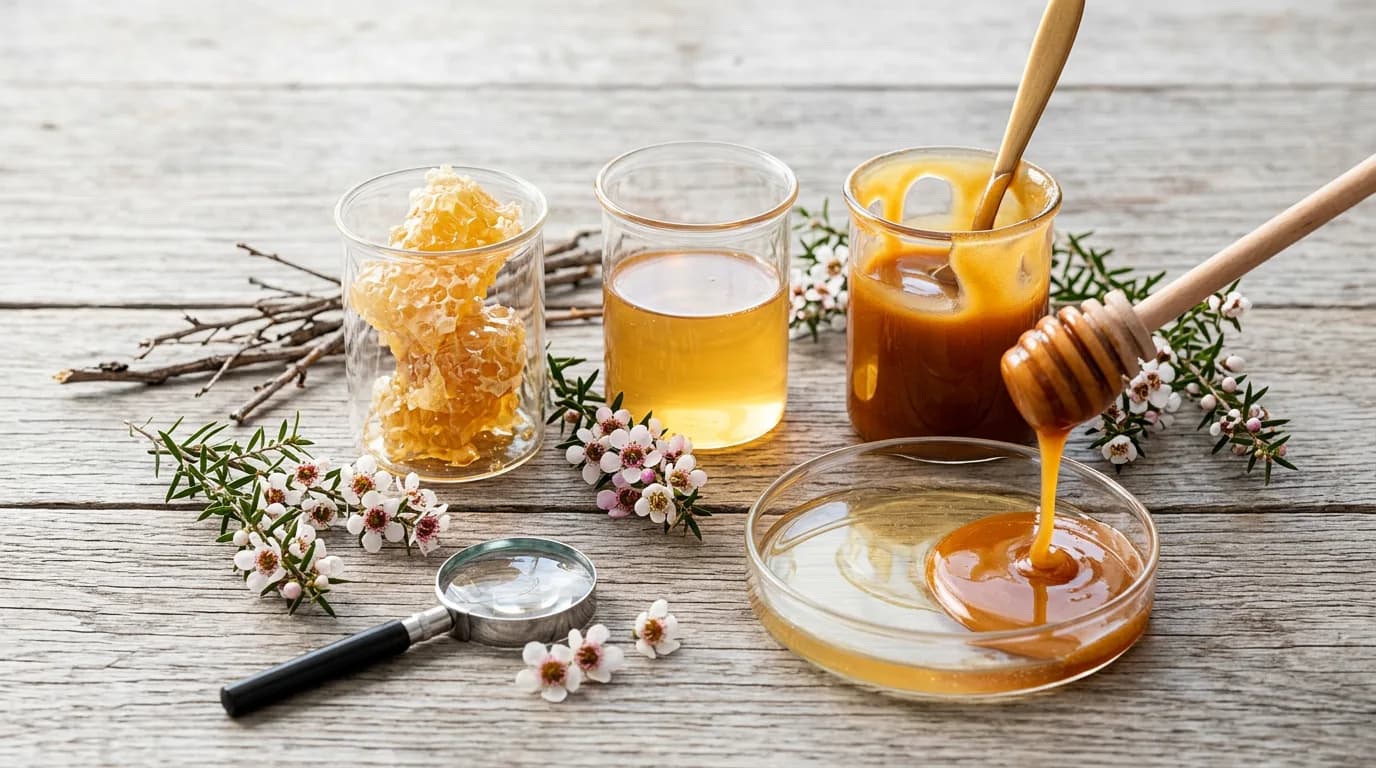
A weathered wooden table holds a cluster of small unlabeled glass vessels arranged like a scientist's specimen set: one with raw honeycomb fragments, one with pale amber honey, one with darker aged manuka honey, alongside a scattering of fresh Leptospermum scoparium sprigs with tiny white-pink blossoms and a few dried scrubland twigs. A magnifying glass rests near the blossoms, and a simple wooden dipper drizzles honey into a shallow dish, showing the transition from thin nectar-like liquid to thick mature honey side by side.

The plant

Manuka honey begins with a single species: Leptospermum scoparium, a shrubby tree native to New Zealand and southeastern Australia. It flowers for just two to six weeks each summer, depending on altitude and latitude. Bees must work fast — and beekeepers must place hives precisely within dense L. scoparium stands to ensure monofloral collection.

The plant thrives in poor soils, regenerating scrubland, and coastal margins. It is not farmed; it is foraged. This is part of what makes genuine Manuka honey scarce and difficult to scale.

What makes it different

All honeys are antimicrobial to some degree — most through hydrogen peroxide generated by the enzyme glucose oxidase. Manuka honey is unusual because it contains a second, independent antimicrobial system driven by methylglyoxal (MGO), a compound derived from dihydroxyacetone (DHA) present in the nectar of L. scoparium.

This non-peroxide activity is stable to heat, light, and catalase — unlike hydrogen peroxide activity, which is easily destroyed. It is this stability that makes Manuka honey interesting for clinical applications.

From blossom to jar

The journey from flower to jar involves several stages: nectar collection by bees, enzymatic conversion in the hive, dehydration to below 20% moisture, harvesting, extraction, and — critically — maturation. Fresh Manuka honey contains high DHA but relatively low MGO. Over months of storage, DHA converts non-enzymatically to MGO, increasing the honey's antibacterial potency.

This is why freshly harvested Manuka honey may test lower on MGO assays than the same batch tested six months later.

The grading systems

Several systems exist to grade Manuka honey potency. The most widely recognised is the Unique Manuka Factor (UMF), which combines MGO concentration, leptosperin content, and HMF levels into a single rating. The MGO grading system measures methylglyoxal concentration directly in mg/kg.

Understanding what these numbers mean — and what they don't — is essential for making informed choices about which grade suits your needs.

Sarah L
Manuka Clinic

Related articles

Primer
Manuka Honey for COPD: Natural Respiratory Support

An evidence-informed look at how authentic, UMF™-certified Manuka Honey may complement COPD management, including the science, safety considerations, and practical daily use.

How-to
How to Treat a Wound Infection Naturally

Learn how to recognise the signs of a wound infection, understand supportive home care, and explore the laboratory and clinical evidence behind natural remedies like manuka honey — including important cautions for chronic, diabetic, and severe wounds.

Research
Manuka Honey and Eczema

An educational look at manuka honey and eczema — what the lab and clinical research actually shows, what it doesn't, and the safety points anyone considering topical or oral use should know before trying it.

Topical
GLP-1 Side Effects: How Manuka Honey Helps

An educational guide to the digestive side effects common with GLP-1 medications like semaglutide and tirzepatide, and how UMF™ certified Manuka Honey may offer complementary support — with an honest look at what the current evidence does and does not show.

Primer
Manuka Honey for Asthma: The Natural Anti-Inflammatory

Explore the evidence behind using Manuka honey for asthma, including its anti-inflammatory compounds, safety considerations, and what the research does and doesn't show about airway and lung health.

Research
Beyond the Jar: New Manuka Honey Powders and Dressings on the Horizon

A look at early-stage lab research turning manuka honey into powders, scaffolds, and dressings — what's been tested, what it means, and how far the evidence currently reaches.