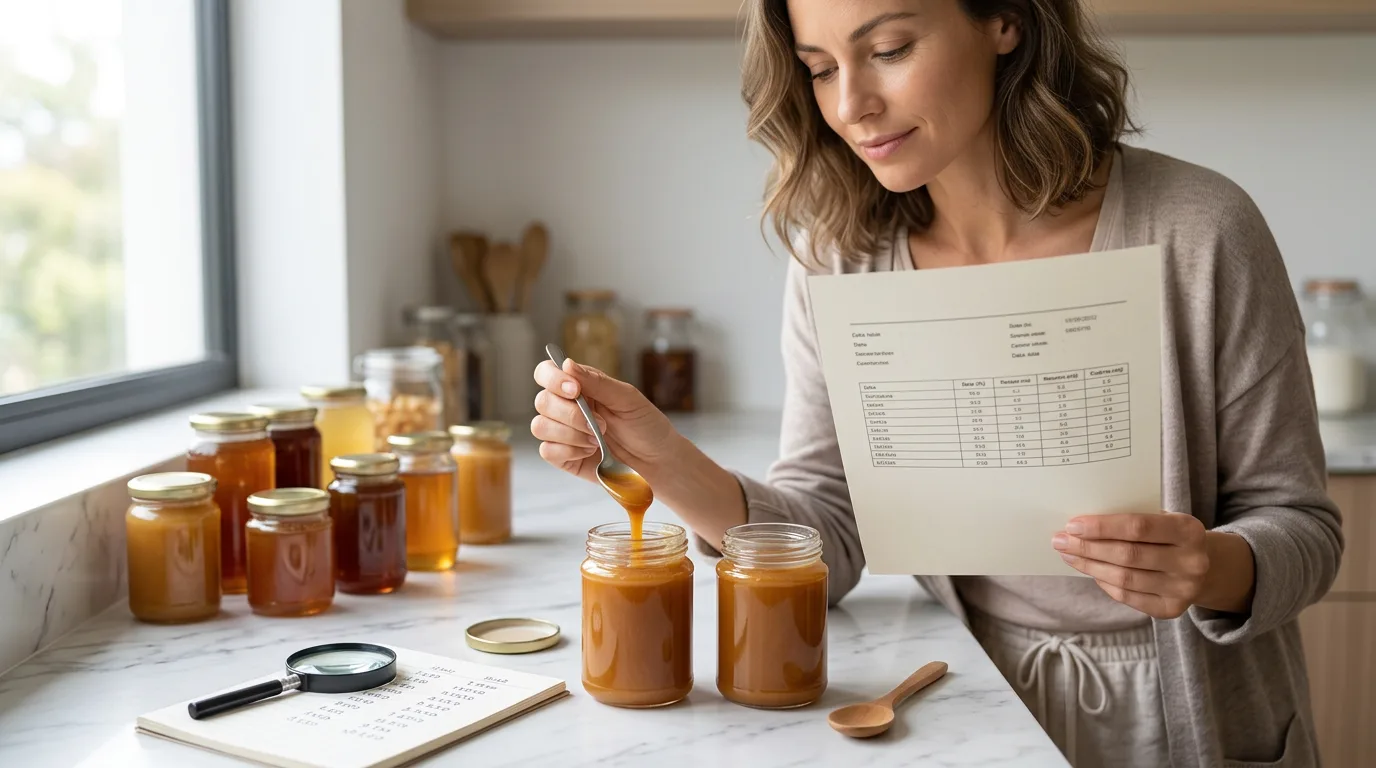
Manuka honey is produced from the nectar of the Leptospermum scoparium (manuka) tree, native to New Zealand and parts of Australia. Unlike a standard supermarket honey blend, it is sold with a specific numeric grade attached to it, and that grade — not just the word "manuka" on the label — is largely what determines the price of the jar.
What Makes Manuka Honey Chemically Different
The headline difference between manuka honey and other honeys comes down to a compound called methylglyoxal, or MGO. In laboratory tests, honeys with higher measured methylglyoxal (MGO) levels tended to show greater antibacterial activity, though the effect varied depending on the bacteria tested. This is a laboratory finding from well-characterised New Zealand manuka honeys — it tells you that MGO content and antibacterial performance are generally linked in a dish, not that a given jar will produce a particular effect once eaten or applied at home. Regular multifloral honey typically contains far lower and less consistent levels of MGO, which is part of why it isn't graded or sold on this basis at all.
UMF and MGO: Two Different Labels for the Same Idea
If you've compared jars side by side, you've likely noticed two different numbering systems. UMF (Unique Manuka Factor) and MGO (methylglyoxal, measured in mg/kg) are two different labelling systems used on manuka honey, each with its own numeric scale and testing method. UMF is a broader certification that incorporates several chemical markers alongside MGO, while an MGO label reports the methylglyoxal concentration directly. Neither system is more "correct" than the other — they're simply different ways of documenting the same underlying chemistry, and reputable sellers will generally quote one or the other clearly rather than relying on vague terms like "active" or "bio-boost" with no attached number.
Standard supermarket honey blends are typically not tested for methylglyoxal content and are not sold with a UMF or MGO rating on the label. That absence of testing is precisely what keeps blended and generic honey cheaper — there's no laboratory verification step built into the cost, and no batch-level certification behind the jar.
What You're Actually Paying For
Genuine graded manuka honey usually carries a batch or test reference number on the label that can be checked against an independent laboratory certificate published by the seller or a testing body. That traceability, along with the testing itself, is a real cost of production, and it shows up in the retail price. Honeys with higher UMF or MGO numbers are generally priced higher per jar, reflecting lower yields, additional laboratory testing, and batch certification costs. Products labelled "manuka blend" typically mix manuka honey with other floral honeys and are generally cheaper than mono-floral, independently graded manuka honey — useful to know if a jar's price seems unusually low for a stated grade.
Put simply: price differences between manuka and standard supermarket honey largely reflect certification, sourcing region, and production volume rather than any single standardised measure of potency. A higher number on a jar reflects more of the tested compound and more verification behind that number — it is not evidence that grading itself is inconsistent or unreliable.
What Human Research Has Actually Tested
Most of the antibacterial evidence above comes from laboratory work, and it's worth being clear-eyed about how far that extends into everyday consumption. A small randomized human trial in healthy adults found daily manuka honey (UMF 20+) consumption for four weeks was not associated with allergic markers (IgE) or increased glycation byproducts, and did not significantly change gut bacterial populations. The same study found no additional digestive benefit from either honey tested. That trial involved 20 healthy adults over a four-week period comparing manuka honey against a multifloral honey — a useful, if small, safety signal for everyday oral consumption, but not a study of wound healing, skin conditions, or any therapeutic outcome, and its findings shouldn't be extended beyond the healthy-adult population it examined.
An Honest Look at the Open Questions
Manuka honey research is active and still maturing as a field. A recent review of the manuka honey research literature notes that grading systems, safety and efficacy claims, and contaminant limits remain debated topics among researchers. This doesn't undermine the value of UMF or MGO grading as a purchasing guide — both remain the most transparent, laboratory-backed way to compare jars — but it does mean that broader questions about optimal dosing, permissible contaminant thresholds, and the strength of efficacy claims across different uses are still being worked out at a research level, separate from the reliability of the grading numbers themselves.
Storage
As with any honey, manuka honey should be stored at room temperature away from direct heat and sunlight to help preserve its texture and consistency. This is a simple storage habit, not a claim about potency retention.