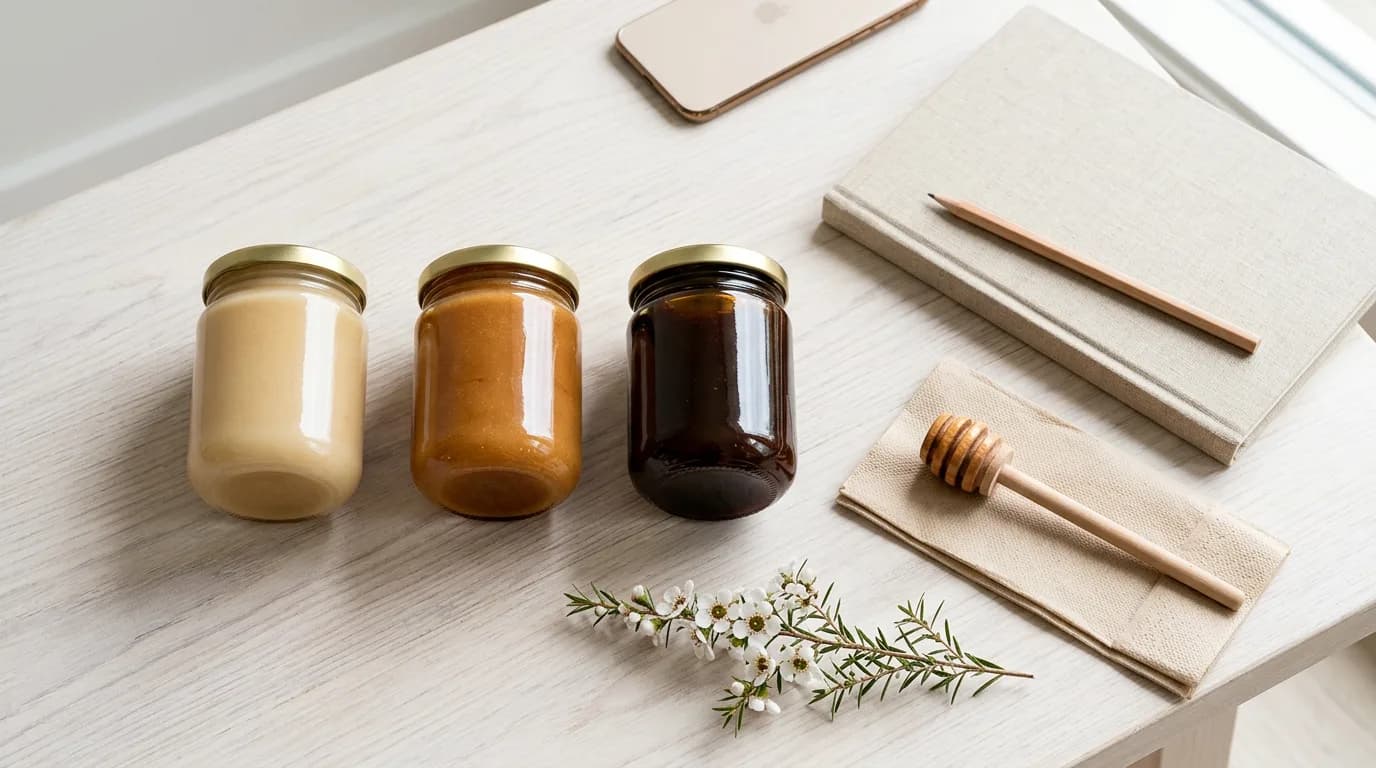
Manuka honey is made by bees foraging on the flowers of Leptospermum scoparium, a shrub native to New Zealand and also found in parts of Australia. A good jar tells you its grade, its floral source, who packed it and which batch it came from, and a few quick checks on the label confirm you are buying what the front of the jar promises.
1. Read the grade: UMF and MGO
Most manuka jars carry a number, and it will usually be either a UMF grade or an MGO figure. MGO is methylglyoxal, measured in mg/kg. UMF certifies methylglyoxal together with markers that confirm genuine manuka (leptosperin and DHA). An MGO grade states methylglyoxal alone. The two overlap, and you can compare a UMF grade with an MGO figure using the equivalences below. A higher grade means more certified MGO.
| UMF grade | Minimum MGO (mg/kg) | How we label it |
|---|---|---|
| UMF 5+ | 83+ | MGO 83+ (UMF 5+) |
| UMF 10+ | 263+ | MGO 263+ (UMF 10+) |
| UMF 15+ | 514+ | MGO 514+ (UMF 15+) |
| UMF 20+ | 829+ | MGO 829+ (UMF 20+) |
| UMF 24+ | 1122+ | MGO 1122+ (UMF 24+) |
| UMF 26+ | 1282+ | MGO 1282+ (UMF 26+) |
| UMF 28+ | 1450+ | MGO 1450+ (UMF 28+) |
So a jar marked "MGO 514+" and a jar marked "UMF 15+" sit at the same level. When you compare two jars, line them up on this table first.
2. Read the exact floral wording
The words around the grade matter as much as the number. Labels such as 'manuka blend', 'multifloral' or 'manuka-style' describe honeys that are not the same as a honey labelled monofloral manuka, so it is worth reading the exact wording on the jar.
There is a laboratory reason to care about floral source. In a laboratory study that used honeys with known origin and floral source, manuka honey generally inhibited bacterial growth more than manuka-kanuka blends, kanuka or clover honey. The pattern differed between bacterial species. That was a laboratory comparison of honeys of known origin, not a trial in people. It does show why a jar that names its floral source clearly and states a grade gives you the most to go on.
3. Look for batch number, date and packer
Three details on the jar make it traceable:
- Batch or lot number and best-before date. Look for a batch or lot number printed on the jar or lid, and a best-before date. A batch number is what allows a jar to be traced back to the packer.
- Packer or exporter details. Check that the label gives the packer's or exporter's name and a physical address, not just a brand name or website, and that it states the country of origin clearly.
- Printing on the jar itself. Check that the tamper seal is intact and that the MGO or UMF figure, the batch code and the packer details are all printed on the jar itself rather than only on outer packaging.
Reputable producers print all of this as a matter of course, so finding it is a good sign.
4. Verify any certification mark
A logo is a starting point. If the jar carries a certification mark or licence number, check it against the certifying body's public licensee or brand register instead of relying on the logo alone. The check takes a minute on a phone. A brand that appears on the register, with a licence number matching the jar, has put its grade in front of an independent scheme.
5. Compare prices sensibly
Higher UMF or MGO grades generally cost more per jar, so comparing price per 100 g within the same grading scale and from the same certification scheme is more meaningful than comparing headline prices. Jar sizes vary widely, and a smaller jar can look cheaper while costing more per gram.
A very low price for a jar claiming a high UMF or MGO grade is a reason to look more closely at the certification, batch and packer details before buying. If the register entry, batch code and packer address all check out, you can buy with more confidence.
A quick checklist for the shelf
- Is the floral wording clearly monofloral manuka, rather than 'blend', 'multifloral' or 'manuka-style'?
- Is there a UMF grade or MGO figure, and can you match it to the table above?
- Is there a batch or lot number and a best-before date?
- Are the packer's name, physical address and country of origin on the jar?
- Does the certification licence number appear on the certifier's public register?
- Is the tamper seal intact, with the key details printed on the jar itself?
- Have you compared price per 100 g within the same grade and scheme?
A jar that passes all seven checks gives you a clear grade, a traceable batch and a named packer, so you know what you are paying for.