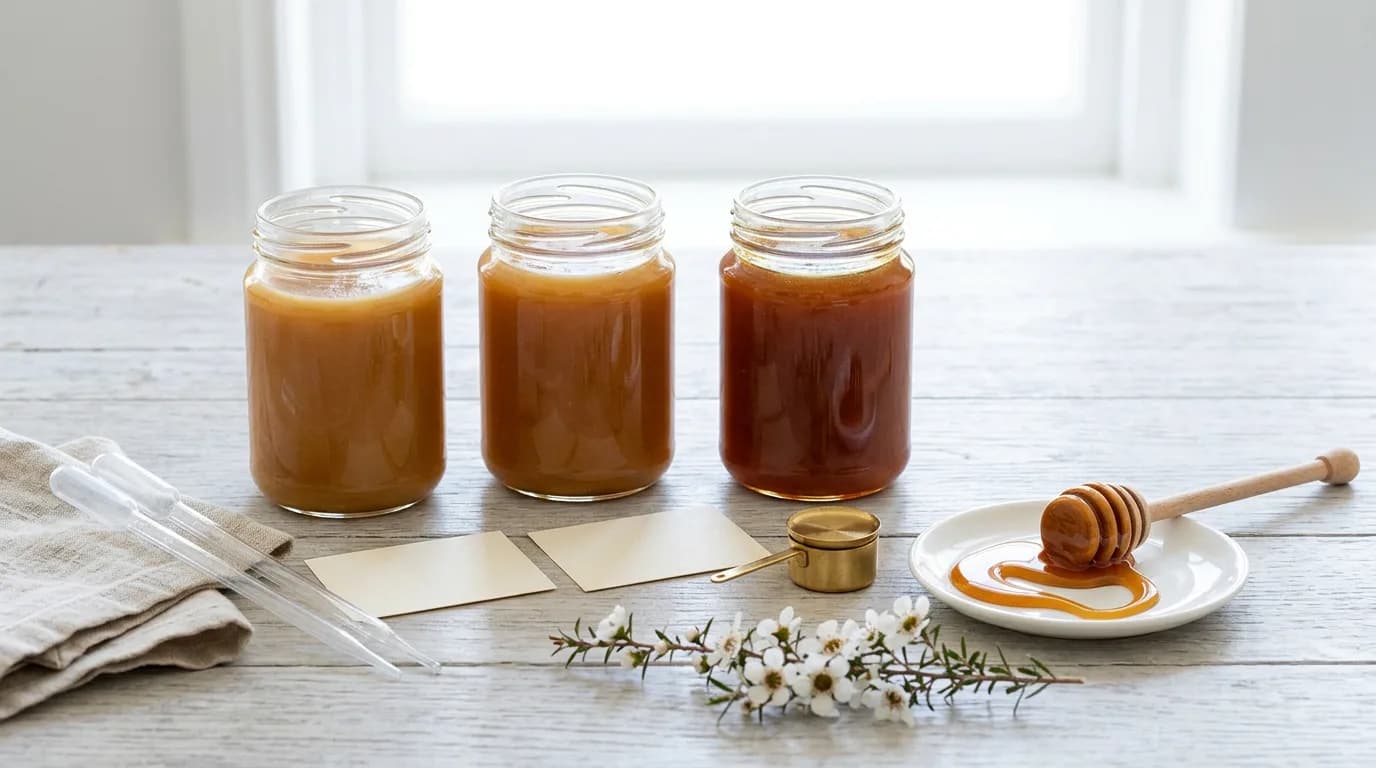
UMF (Unique Manuka Factor) is a New Zealand-developed grading system that measures several natural markers found in manuka honey, including methylglyoxal, DHA, and leptosperin. MGO grading is a rating system that states a honey's methylglyoxal content directly, expressed in milligrams per kilogram. Both numbers appear on jars of manuka honey, produced primarily from the nectar of the Leptospermum scoparium shrub, native to New Zealand and parts of Australia, and both exist to help a buyer judge quality at a glance — they're just doing that job in different ways.
UMF and MGO Measure Overlapping, Not Identical, Things
UMF and MGO are two different labelling systems that describe overlapping but not identical measurements of the same raw honey. A UMF rating pulls methylglyoxal together with two other compounds, DHA and leptosperin, into a broader authenticity and potency profile, while an MGO number reports methylglyoxal content on its own. In practice, a UMF 10+ jar and one carrying a roughly equivalent MGO number aren't reporting exactly the same thing, even when the underlying honey is very similar.
The two may also have been tested under different schemes, so it's worth checking who issued the rating. Genuine UMF-certified honey carries a licence number that buyers can check against the UMF Honey Association's online register, and some MGO-labelled brands publish batch test results you can look up by batch code — a quick way to confirm a jar's grade wasn't invented for the label.
What the Numbers Are Backed By
The reason methylglyoxal earns its own grading system comes down to laboratory chemistry. Laboratory studies indicate that methylglyoxal, the compound directly measured by the MGO rating, has demonstrable in-vitro antibacterial activity against certain bacteria, including biofilm-associated forms. This reflects laboratory findings only and is not a claim about treating infections in people. It explains why the compound is worth measuring in the first place — not what a jar of honey will do once it leaves the shelf.
Methylglyoxal doesn't appear to work entirely alone, either. In vitro, anti-biofilm activity against S. aureus tended to increase with higher manuka honey/methylglyoxal content, but methylglyoxal alone did not reproduce this effect, indicating other honey components also contribute. This is laboratory data and does not describe an effect in the human body. That finding is one reason UMF's broader marker panel can be read as capturing more of the whole picture than an MGO number alone, even though MGO's single-compound reading is easier to compare directly across brands.
Safety at Common Grades
Buyers weighing UMF against MGO are usually also asking whether a higher number means more risk, and the closest available human evidence is reassuring for healthy adults. A small clinical trial in healthy adults found that daily consumption of UMF 20+ manuka honey for four weeks did not trigger allergic markers, alter gut bacterial populations, or change a glycation biomarker, supporting oral safety in this healthy population; effects in other populations, including people managing diabetes or blood sugar levels, were not studied, and anyone with a known allergy to honey, bee products or pollen should avoid manuka honey regardless of grade. That's a comparatively high grade tested over a meaningful stretch of daily use, which is useful context if you're choosing between, say, a UMF 15+ and a UMF 20+ jar rather than picking on price alone.
Comparing Prices Without Overpaying
Jars with higher UMF or MGO numbers are typically priced at a premium, reflecting the reported concentration of the rated compounds, and that premium tends to hold whichever system is printed on the label. When comparing prices between UMF-graded and MGO-graded jars, some buyers refer to conversion tables published by grading organisations rather than assuming the two numbering systems are directly interchangeable. On the UMF Honey Association's scale, UMF 10+ corresponds to at least 263 mg/kg MGO, UMF 15+ to 514 mg/kg and UMF 20+ to 829 mg/kg. Checking a published conversion table alongside the batch code on the jar is usually enough to tell whether a price gap reflects genuinely different potency or just a different labelling convention.
Which Number Should You Buy On
If a single, directly comparable read on methylglyoxal content is what matters to you, MGO gives the more literal number. If you'd rather a certification that also checks DHA and leptosperin — markers of authenticity and of how MGO will develop on the shelf — UMF offers a broader profile of the same jar, with its number still keyed to MGO. Either way, verifying the licence number against the issuing body's database and comparing like-for-like grades will tell you more about what's actually in the jar than the label's marketing on its own.
References
- (2011). Methylglyoxal: (active agent of manuka honey) in vitro activity against bacterial biofilms. International forum of allergy & rhinology. doi:10.1002/alr.20073
- (2014). Manuka-type honeys can eradicate biofilms produced by Staphylococcus aureus strains with different biofilm-forming abilities. PeerJ. doi:10.7717/peerj.326
- (2010). Demonstrating the safety of manuka honey UMF 20+in a human clinical trial with healthy individuals. The British journal of nutrition. doi:10.1017/s0007114509992777
- (2024). An updated review of functional ingredients of Manuka honey and their value-added innovations. Food chemistry. doi:10.1016/j.foodchem.2023.138060