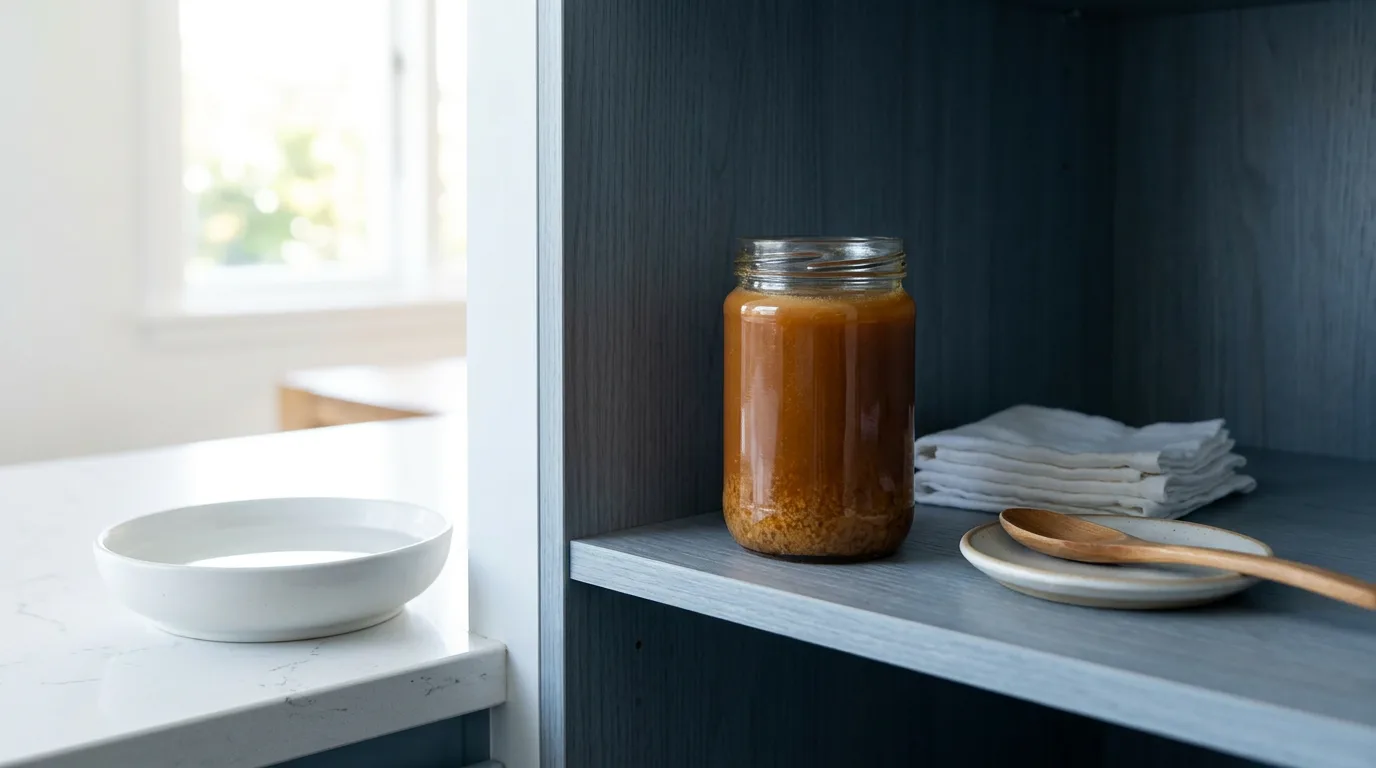
Manuka honey is typically sold in sealed jars and is best kept tightly closed between uses to limit exposure to air and moisture. Keeping the lid secure, the jar dry, and the honey away from strong heat is the simplest way to protect its texture, aroma, and overall condition for as long as possible.
The Basics of Good Storage
Storing honey away from direct sunlight and away from heat sources such as stovetops or sunny windowsills is a common recommendation for preserving its appearance, aroma, and texture. A kitchen cupboard or pantry shelf, out of direct light and away from the oven or stovetop, suits most households well. The goal is simply to keep the environment stable — a jar that goes through repeated temperature swings or sits in direct sun tends to change texture and aroma faster than one kept somewhere cool and consistent.
Manuka honey does not require refrigeration and is generally stored at room temperature, as chilling can cause faster or coarser crystallisation. If a jar does crystallise, that is a completely normal part of honey's chemistry rather than a sign of a problem, and it can be reversed. Crystallisation is a natural physical process in honey. Many people reverse it by gently warming the jar in warm water rather than microwaving it, as a matter of texture and convenience. A gentle warm-water bath softens the crystals back to a pourable consistency without exposing the jar to the very high, uneven heat a microwave can produce, which can scorch honey in patches.
What the UMF or MGO Number Does and Doesn't Tell You
Every jar of graded manuka honey carries a UMF or MGO figure on the label, and it's worth being clear about what that number actually represents. UMF and MGO numbers on a label are grading figures describing chemical markers measured in the honey at the time of testing; they are not instructions for how the product should be stored. In other words, the number reflects what a laboratory measured in that specific batch when it was tested — it is not a running measurement that updates on your kitchen shelf, and it isn't a set of storage directions.
This distinction matters because of something researchers have observed when testing honey that has already reached shop shelves. Laboratory testing of commercially available Manuka honey samples has found that measured antibacterial activity does not always match the UMF grade on the label, a pattern the researchers linked to possible changes in methylglyoxal levels over time in stored product. This was an observational finding from a limited sample of purchased honeys, not a controlled study of storage conditions, and it should not be read as guidance on how to store honey to preserve any particular effect. In practical terms, no household storage routine has been tested and shown to preserve or raise a honey's antibacterial measurement, so the steps in this article are about protecting the honey's everyday quality — its texture, aroma, and appearance — rather than a promise about any laboratory measurement staying fixed.
Honey's Shelf Life
Honey in general has a long practical shelf life when kept sealed and dry, though its colour, aroma, and texture can change gradually with age. A tightly sealed jar, kept cool and dry and out of direct sunlight, is doing the main work of keeping it in good everyday condition for a long time. Darkening, a subtle change in aroma, or a shift in texture over months or years is a normal part of that ageing process rather than a sign that something has gone wrong with the jar.
Choosing and Buying with Confidence
Because the UMF or MGO figure reflects a specific batch at the time it was tested, the reliability of that figure comes down to the testing behind it, not to anything a buyer does at home afterwards. Buying from sellers who provide batch-specific UMF or MGO test certificates can help a buyer confirm that a jar matches its labelled grade. Checking for a batch number and a matching certificate before purchase is a straightforward step, and one that has nothing to do with how the jar will later be stored in your kitchen.
Price is part of this picture too. Higher stated UMF or MGO grades are generally priced higher, reflecting the cost of testing and certification rather than any particular storage requirement. A higher number on the label is not asking you to store the jar any differently — a cool, dark cupboard and a tightly closed lid suit every grade of manuka honey equally well.
Taken together, the most reliable way to look after a jar of manuka honey is also the simplest: keep the lid on tight, keep it out of the sun and away from heat, store it at room temperature rather than in the fridge, and choose a jar with a verifiable batch certificate in the first place. Those few habits protect the honey you've bought for as long as you're likely to keep it in the cupboard.
References
- (2019). Antibacterial activity of varying UMF-graded Manuka honeys. PloS one. doi:10.1371/journal.pone.0224495