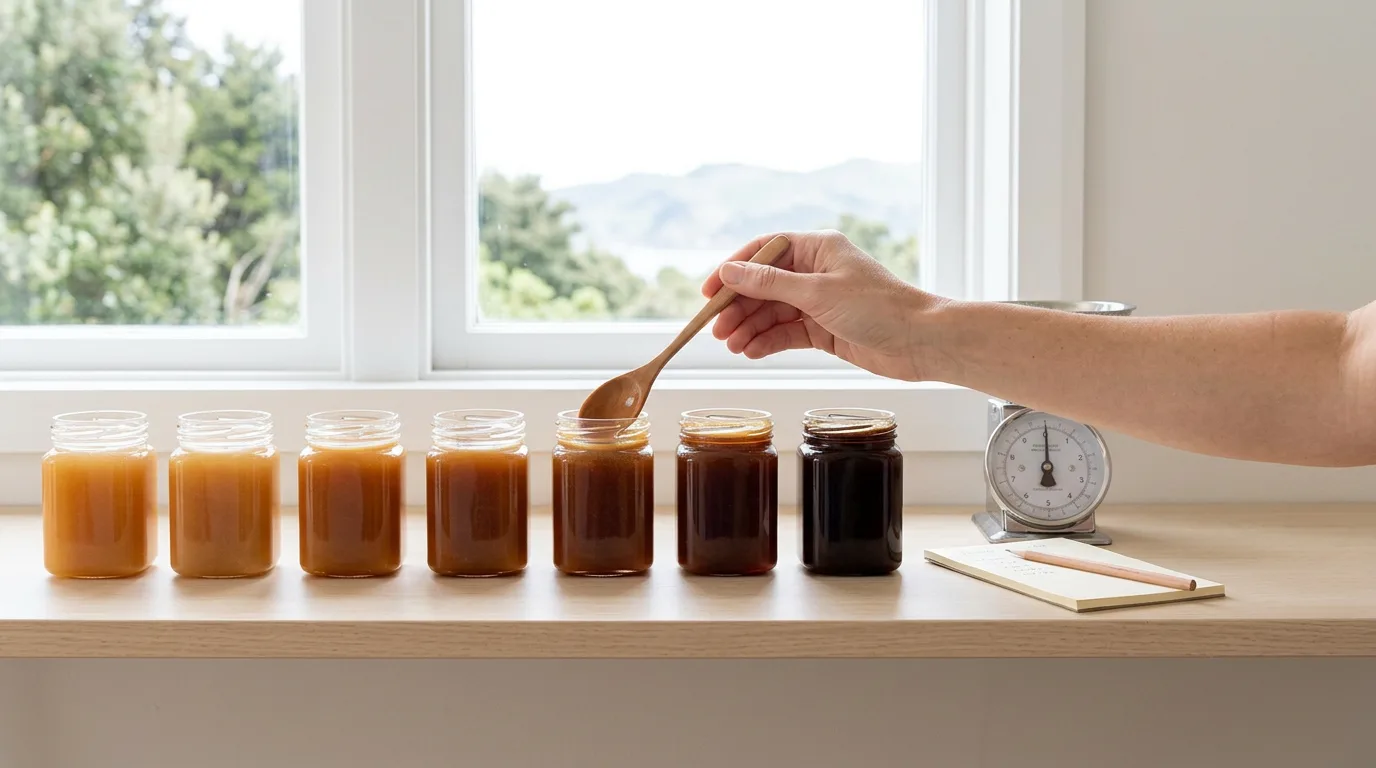
Higher UMF grades carry more certified methylglyoxal (MGO), the compound manuka honey is graded on, so each step up the scale gives you a measurable increase in what the label certifies. Whether that makes a higher grade better value depends on what you are paying the grade for.
What a higher UMF number gives you
UMF (Unique Manuka Factor) is a commercial grading system for manuka honey. Its grade is linked to methylglyoxal (MGO) content, alongside other chemical markers used in the grading scheme. UMF certifies MGO together with markers that confirm genuine manuka (leptosperin and DHA), whereas an MGO grade states methylglyoxal alone. The two scales overlap, and you can line them up using fixed equivalences:
| UMF grade | Minimum MGO |
|---|---|
| UMF 5+ | MGO 83+ mg/kg |
| UMF 10+ | MGO 263+ mg/kg |
| UMF 15+ | MGO 514+ mg/kg |
| UMF 20+ | MGO 829+ mg/kg |
| UMF 24+ | MGO 1122+ mg/kg |
| UMF 26+ | MGO 1282+ mg/kg |
| UMF 28+ | MGO 1450+ mg/kg |
Some brands label their honey by MGO value (mg/kg) rather than UMF. The two scales are different grading systems and are not interchangeable numbers, so check how the labels relate before comparing jars. The table above does that work for you: find the MGO figure on one jar, find the matching UMF grade, and you are comparing like with like.
A higher grade means more certified MGO. That is the plain, checkable difference between a UMF 10+ jar and a UMF 20+ jar.
What laboratory work says about MGO
Laboratory research gives the clearest reason to pay attention to MGO level. One set of experiments compared well-characterised New Zealand honeys and blends against bacterial biofilms.
In laboratory biofilm experiments, higher proportions of manuka-derived honey, and therefore more methylglyoxal, were associated with greater anti-biofilm activity against Staphylococcus aureus. Methylglyoxal alone was not enough to eradicate the biofilms, which suggests other honey components contribute. These findings come from in-vitro work and have not been shown to translate into clinical benefit.
A separate laboratory model looked at how much methylglyoxal was needed once bacteria were growing as a biofilm.
In a laboratory biofilm model, methylglyoxal needed roughly 5 to 12 times the concentration to act against biofilm-embedded MRSA and Pseudomonas aeruginosa as against free-floating cells (MRSA 0.5–3.6 mg/mL vs 0.08–0.3 mg/mL; P. aeruginosa 1.8–7.3 mg/mL vs 0.15–1.2 mg/mL). This is in-vitro evidence from isolated methylglyoxal, not from commercial honey.
Together these studies show why MGO is the figure grading schemes put on the label. Neither is a clinical trial, so they explain the chemistry rather than promise a result from any jar.
Where the value comes from
Retail price generally rises as the UMF or MGO grade increases, so higher grades typically cost noticeably more per jar. That makes a fair comparison worth the effort.
The UMF number reflects a measurement taken at a point in time, and brands price on that number. Price per jar alone therefore does not show how much of the graded compound a buyer is getting. Comparing price against the licensed grade, batch date and jar size gives a fairer value comparison.
In practice, that gives you three questions to ask of any jar:
- What is the licensed grade? Convert it to MGO using the table if you are comparing with an MGO-labelled brand.
- What is the batch date? The grade is measured at a point in time, so a recent batch tells you more than an undated label.
- What is the jar size? A larger jar at a higher grade can cost less per gram of certified MGO than a small jar at a lower grade, so work out the price per gram before deciding.
Matching the grade to your purpose
If you want manuka honey for its graded MGO content, a higher grade is the one that delivers more of it, and the extra cost buys a higher certified figure. A buyer who wants honey purely as a food or sweetener is paying extra for a grading attribute (MGO level) that is not a culinary specification. A lower grade or a regular monofloral honey is a cheaper option for that purpose.
So higher UMF is not automatically the best-value choice for every shopper. It is the better-value choice when the certified MGO is what you are buying.
Buying checks that protect your money
When buying a UMF-labelled jar, look for the licensee details and a traceable batch or licence number from the UMF Honey Association. Be wary of a UMF number printed with no licence information.
Once the jar is home, store honey in a sealed container away from direct heat and sunlight. Storage conditions are one factor a buyer can control after purchase.
The practical takeaway
Choose the grade by purpose, then compare jars on licensed grade, batch date and price per gram, using the UMF-to-MGO table whenever labels differ. A verified licence number on a jar at the grade you need is better value than a higher number you do not need or one you cannot trace.