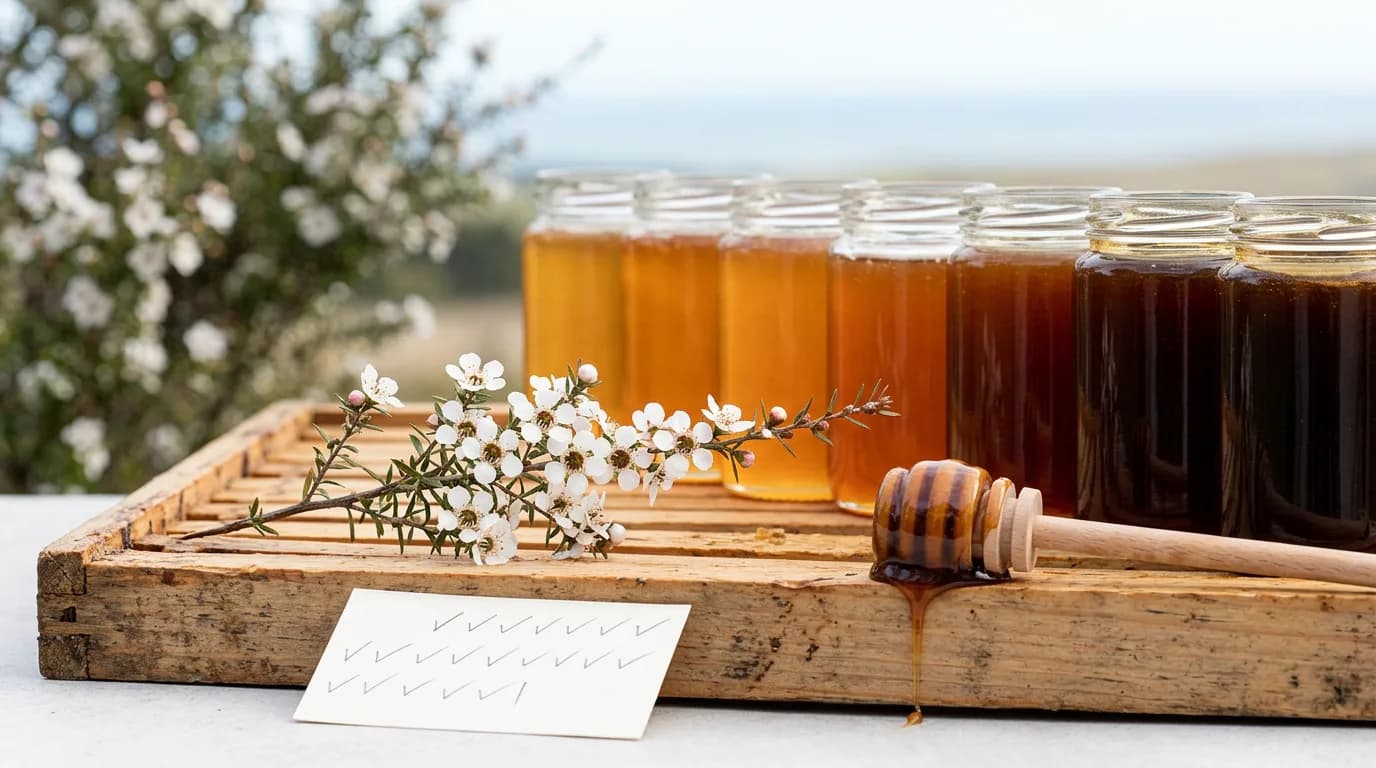
Manuka honey is produced by honeybees foraging on the flowers of the manuka shrub (Leptospermum scoparium), which grows in New Zealand and parts of south-eastern Australia. Manuka flowers for only a few weeks each year. The timing and length of flowering vary with region, altitude and weather, so beekeepers have a narrow window in which bees can forage the flowers.
The short harvest window comes straight from the plant. Beekeepers cannot extend it; they can only be ready when it opens.
One plant, one brief bloom
Manuka honey is made from the nectar of Leptospermum scoparium flowers, and a 2024 review describes it as a highly prized product in an increasingly competitive global market.
Because flowering shifts with region, altitude and weather, there is no single calendar date that applies everywhere. A cold or wet spell during bloom can shorten the time bees spend on the flowers. Beekeepers therefore plan around the plant, positioning hives where manuka grows and working within whatever days the weather allows.
Why the window matters for purity
Honey sold as manuka is expected to come mainly from manuka nectar. Other flowers blooming at the same time can dilute the nectar, which is one reason producers test batches.
Floral source is tracked for a reason. In laboratory conditions, honeys of differing floral source showed different levels of bacterial growth inhibition, with manuka generally ahead of manuka-kanuka blends, kanuka and clover. These are in-vitro results and do not show an effect in people.
In practice, a short bloom means the foraging period that produces a genuine manuka batch is tightly bounded. Batch testing confirms what the bees actually gathered during it.
What the grade on the jar tells you
UMF is a grading system that reflects the levels of marker compounds in the honey, including methylglyoxal (MGO). The number on the label is a lab-measured grade, not a measure of how long or how well the honey was harvested.
UMF certifies MGO together with markers that confirm genuine manuka (leptosperin and DHA), while an MGO grade states methylglyoxal alone. The two overlap, and you can compare them using these equivalences. A higher grade means more certified MGO.
| Site grade label | Minimum MGO |
|---|---|
| MGO 83+ (UMF 5+) | 83 mg/kg |
| MGO 263+ (UMF 10+) | 263 mg/kg |
| MGO 514+ (UMF 15+) | 514 mg/kg |
| MGO 829+ (UMF 20+) | 829 mg/kg |
| MGO 1122+ (UMF 24+) | 1122 mg/kg |
| MGO 1282+ (UMF 26+) | 1282 mg/kg |
| MGO 1450+ (UMF 28+) | 1450 mg/kg |
How a short season affects supply and price
Because the harvest window is short and weather-dependent, annual supply of manuka honey can vary from year to year, which can affect price and availability.
Higher-graded manuka honey generally costs more than lower-graded manuka honey or multifloral honey. Buyers can compare grade, batch testing and the producer's traceability information.
Buying and storing manuka honey
When buying, check the label for a recognised grading mark (such as UMF or MGO) with a licensed producer or packer, a batch or lot number, and a country of origin. Unusually cheap jars labelled as manuka warrant caution.
Store manuka honey sealed, at room temperature and away from direct sunlight. Refrigeration is not required, and the honey may crystallise over time.
Knowing how brief the bloom is helps you read a manuka label with confidence. A grading mark, a batch number and clear traceability show that the honey has been tested and tracked from its short season to your shelf.