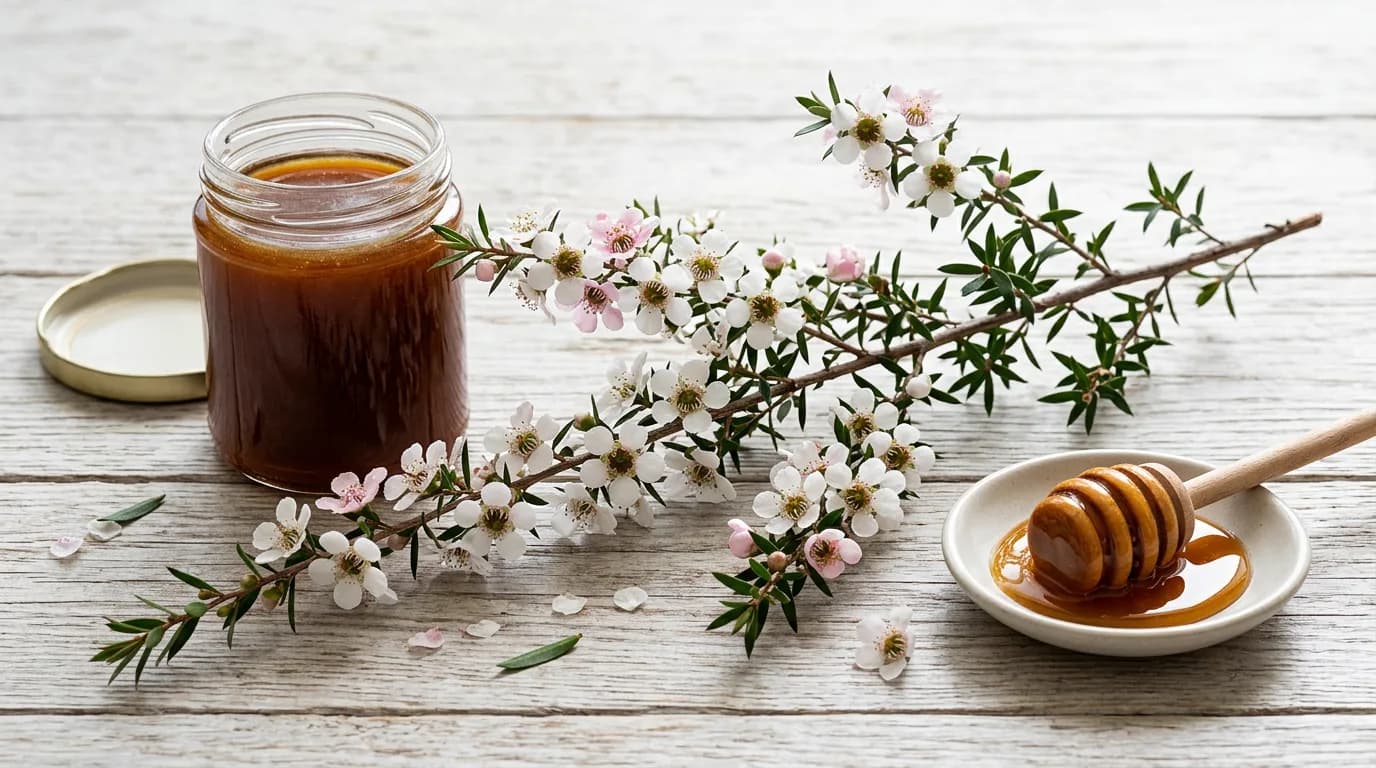
Leptospermum scoparium, known in te reo Māori as mānuka, is a hardy evergreen shrub or small tree native to New Zealand and south-eastern Australia. Manuka honey is made from the nectar of the flowers of Leptospermum scoparium, according to a 2024 review of the honey's functional ingredients.
That link between a tough native plant and a single jar of honey is the reason the tree's flowering habits matter to beekeepers, buyers and anyone curious about where manuka honey comes from.
The plant itself
Manuka is a resilient plant. It grows as a shrub or a small tree and keeps its foliage all year, which is what "evergreen" means. It is a pioneer plant in many landscapes, often among the first woody species to establish on open or disturbed ground. That is why it appears in so many New Zealand hillsides and scrublands.
The name can be confusing. In English, manuka is sometimes called 'tea tree', a name it shares with other plants, including the Australian Melaleuca alternifolia. This is a common source of confusion. When you see "tea tree" on a label, check the Latin name to know which plant is meant. Manuka honey comes from Leptospermum scoparium.
The flowers
Manuka's flowers are the part that matters most for honey. Manuka produces small, five-petalled flowers, typically white and sometimes pink, which can cover the branches during the flowering season. A healthy stand in full bloom can look dusted in white, and the flowers are what the bees visit for nectar.
When manuka flowers
Flowering follows the season. In New Zealand, manuka generally flowers in late spring to summer, roughly November to February. Exact timing and length of flowering vary with region, altitude, local climate and the year, and at any one site flowering is often only a few weeks.
The pattern in brief:
- Region: warmer northern areas and cooler southern areas bloom at different times.
- Altitude: stands higher up the hillside generally bloom later than those at lower levels.
- Weather: the conditions of a given year shape when blooms open and how long they last.
Why a short season shapes the honey
Because the flowering window is short and varies from year to year, the amount of manuka honey produced can vary between seasons and regions. Beekeepers time their hive placement around bloom, and each harvest reflects what that year's flowering allowed.
This also explains part of the price. Manuka honey is usually priced above most other honeys. Price generally rises with the stated grade and can also be affected by the supply and flowering conditions of a given season.
From flower to labelled jar
Bees do not forage on manuka alone. Honey sold as 'manuka' is not necessarily made only from manuka nectar, because bees also forage on other plants. Monofloral and multifloral labels both exist, and buyers can check whether a product carries a grade or a testing statement.
The most widely recognised grading scheme is UMF. UMF (Unique Manuka Factor) is a commercial grading scheme for manuka honey. It is based on laboratory measurement of marker compounds, including methylglyoxal. A grade describes what was measured in the honey and is not a statement about health effects.
UMF certifies methylglyoxal (MGO) together with markers that confirm genuine manuka, namely leptosperin and DHA. An MGO grade states methylglyoxal alone. The two overlap rather than being identical, and you can compare a UMF grade with an MGO figure using these equivalences. A higher grade means more certified MGO.
| UMF grade | Minimum MGO |
|---|---|
| MGO 83+ (UMF 5+) | 83+ mg/kg |
| MGO 263+ (UMF 10+) | 263+ mg/kg |
| MGO 514+ (UMF 15+) | 514+ mg/kg |
| MGO 829+ (UMF 20+) | 829+ mg/kg |
| MGO 1122+ (UMF 24+) | 1122+ mg/kg |
| MGO 1282+ (UMF 26+) | 1282+ mg/kg |
| MGO 1450+ (UMF 28+) | 1450+ mg/kg |
Keeping honey well once you have it
Honey is best stored in a sealed container at room temperature, away from direct heat and sunlight. Crystallisation over time is normal and does not by itself mean the honey has spoiled.
What to take from this
Manuka honey starts as a short burst of small white flowers on a hardy native shrub. When you buy a jar, look for the Latin name Leptospermum scoparium, a grade or testing statement on the label, and the UMF and MGO figures from the table above so you can compare products. Those details connect the jar in your hand to the plant it came from.