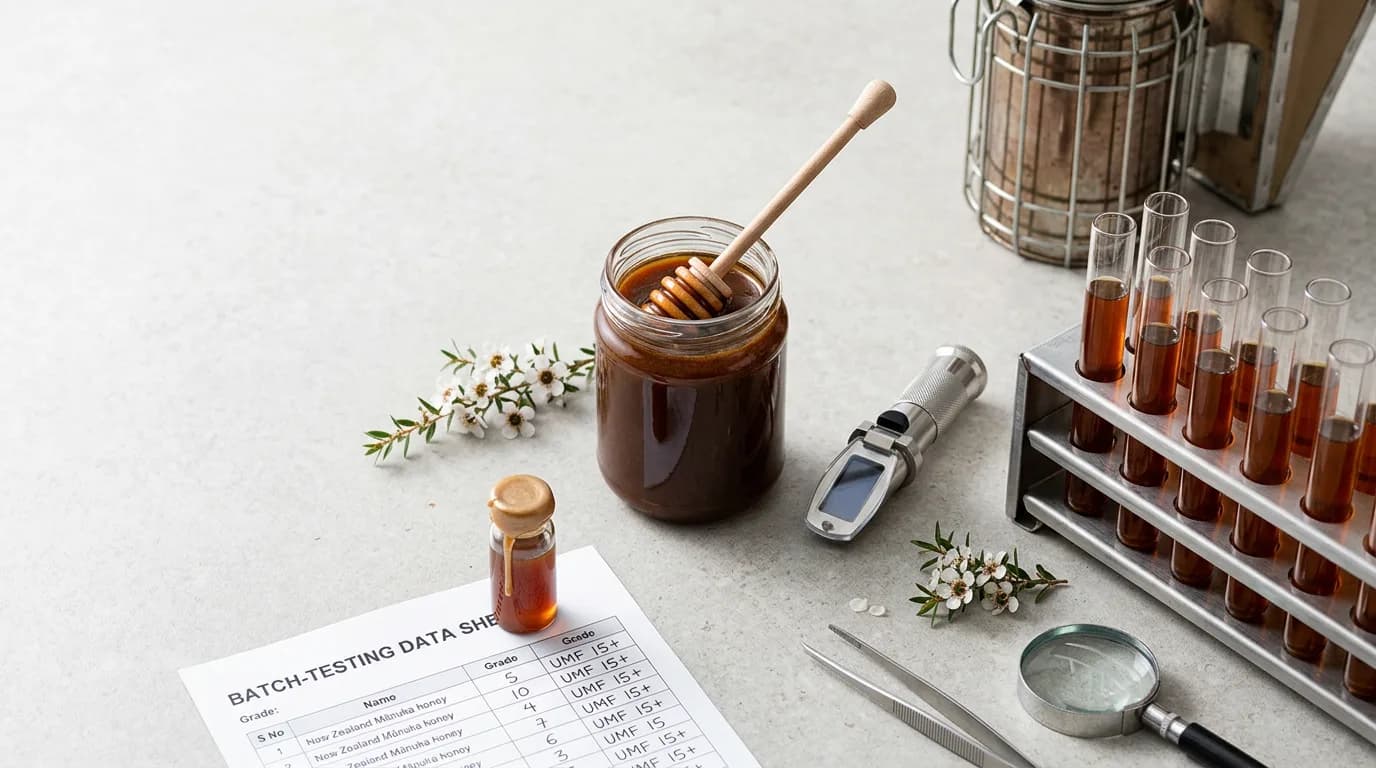
Manuka honey typically costs more than other honeys because it is genuinely harder to produce and because reputable brands pay for independent laboratory testing before every batch reaches a shelf. The price you see at checkout is largely a reflection of a narrow harvest season, strict sourcing requirements, and the cost of grading systems designed to verify what's actually in the jar.
A Short, Unpredictable Harvest
The manuka tree (Leptospermum scoparium) flowers for only a few weeks each year in New Zealand and parts of Australia, creating a narrow harvest window for beekeepers. Because manuka honey is a monofloral honey, meaning bees must forage predominantly on manuka blossom during that short flowering period for the honey to qualify as manuka honey, producers have very little margin for error — if the bees aren't in the right place at the right time, that season's harvest simply won't qualify.
Making things harder, beekeepers often transport hives to remote, rugged manuka-growing regions during flowering season, which adds transport, labour, and site-access costs compared to honey produced from more accessible crops. On top of that, weather during the short flowering window can significantly affect that year's manuka honey yield, contributing to price variability between seasons. A wet, cold flowering period in one region can mean a genuinely smaller national harvest the following year, which shows up in shelf prices regardless of brand.
The Cost of Proving What's in the Jar
Once the honey is harvested, the price story shifts from farming to laboratory work. UMF grading is based on laboratory testing for methylglyoxal (MGO) and other markers, which is why certified manuka honey requires independent lab verification before it reaches the shelf. That testing isn't a one-off certification for a brand — grading systems such as UMF or MGO require each batch to be sent to a laboratory for testing before the honey can be labelled and sold under that grade, adding a testing and certification cost to production. Every batch, not just every brand, has to earn its number.
This is also why higher-numbered UMF or MGO grades are generally priced higher at retail, reflecting both the marketing value of the grade and the cost of the testing required to verify it. A UMF 20+ honey isn't just claiming to be stronger — it has been tested to a threshold that a UMF 5+ honey hasn't met, and that verification work costs money at every step of the supply chain.
It's worth being honest about the limits of what a grading number tells you, though. In one laboratory study testing honeys against 128 bacterial isolates, a higher UMF number did not always correspond to stronger antibacterial activity, suggesting the grading number alone may not fully capture potency — one reason reputable brands pair grading with batch-level lab testing. In other words, the grade is a useful, standardised signal, but it isn't a perfect predictor of performance on its own, which is part of the argument for testing every batch rather than relying on a single fixed number indefinitely. Recent scientific review notes that manuka honey grading, safety, and health-benefit claims remain areas of ongoing debate in the research community, which is part of why independent, verifiable testing carries real cost. That debate doesn't mean grading is meaningless — it means the systems are still maturing, and testing infrastructure is part of what buyers are paying for when they choose a certified product.
Why Mislabelling Pushes Costs Up Too
Because manuka honey commands a premium price, it is a common target for mislabelling and dilution, so buyers are advised to check for an independent grading trademark (such as UMF or a licensed MGO mark) and a batch or test number on the label. The existence of counterfeit and diluted product on the market is itself part of why legitimate producers invest so heavily in traceability and lab documentation — it's the mechanism that lets a genuine UMF 15+ honey distinguish itself from something labelled similarly but never tested.
Getting Value for Money
Prices for manuka honey vary widely between brands and grades, and comparing the certified grade and net weight is a more reliable way to compare value than price alone. A smaller jar of a verified high grade may represent better value than a larger jar with vague or absent grading claims. Once purchased, manuka honey should be stored in a cool, dry place away from direct sunlight, similar to other raw honeys, to help preserve its texture and quality over time — protecting the investment you've already made in a properly graded product.